
Subscribe to our newsletter to keep up with all the latest news and promotions, and automatically receive a welcome discount coupon in your email.

General search
42K

Be the first to know with the 42K newsletter!
CUSTOM

Customise your kit with our CUSTOMIZADOR!
CUSTOMISE NOW!The COO (Chief Operating Officer) of 42K, Julio Mas, was one of more than twenty thousand runners who competed in the Athens Marathon on November 12, and he has told us first-hand about his experience in the oldest and most legendary marathon in the world.
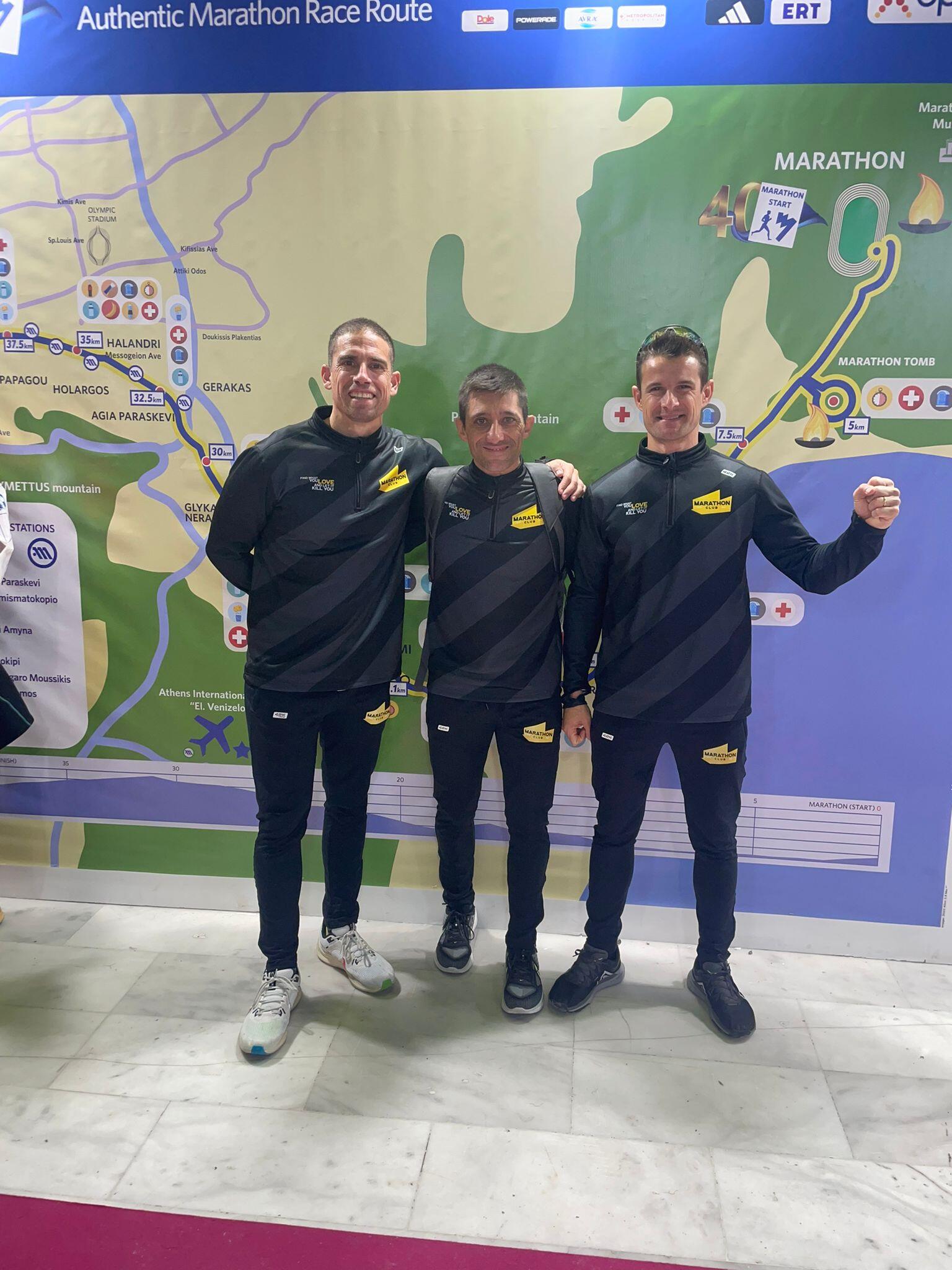
I started running about 30 years ago, at a time when the word “running” wasn’t used, when no more than a thousand runners (and very few women) lined up at the start of any marathon in Spain, and when running through any city caught people’s attention and drew looks of surprise and bewilderment.
I’ve lost count of the races where I’ve worn a race bib (I haven’t forgotten the first one, the Volta a Peu València, at age 14), but I remember every single marathon I’ve run because I’ve put my soul into all of them.
The marathon is a unique event and I’ve always believed that you have to run it with enormous respect, and that, in my opinion, means doing it with maximum personal ambition and the determination to exhaust every last gram of strength.
I have completed the 42.195 kilometres on 14 occasions and, fortunately, I have only experienced the disappointment and ingratitude of dropping out once, in Seville (2014), although that is also part of the greatness of this event. Preparing for a marathon means training for months knowing that on race day you’re putting everything on the line and you’re never safe from an injury, a fall, a stomach problem…
Competing in the Athens Marathon, a dream come true after 30 years of running
I made my marathon debut in 2005, in Valencia. Since then, this race has been part of my sporting life and also, to a large extent, my professional life as Sales Director of 42K, as our sportswear brand has been and is the technical brand for countless marathons in Spain, Italy, Ireland, Portugal, France…
I’ve been lucky enough to experience the marathon as a runner in wonderful settings: Valencia (eight times), Barcelona (twice), Paris, Rome, and Stockholm. But ever since I fell in love with the marathon, I dreamed of one day competing in the legendary Athens Marathon.

After many years of cherishing that dream, in 2023 I was finally able to be at the start in the town of Marathon to face the most historic, the most legendary and, without a doubt, the toughest of the major marathons. I’ll tell you about my experience at the 40th Athens Marathon and I encourage you to one day experience first-hand the indescribable feeling of glory you feel when crossing the finish line at the Panathenaic Stadium in Athens.
Athens Marathon, a unique atmosphere
The Athens Marathon carries the weight of history and legend behind it, something you feel in the atmosphere of the Greek capital in the days leading up to the race. When you lock eyes with other runners in the city’s most touristy spots, you sense that you share a mix of excitement and nervousness, which is naturally the result of knowing you’re in a legendary place and that you’re going to face a unique marathon.

Athens goes all out for the marathon and you can breathe marathon throughout the city. It’s their big sports event of the year and they pamper it in a special way. The percentage of foreign participation is very high, and that translates into huge economic income for hotels, restaurants, shops…
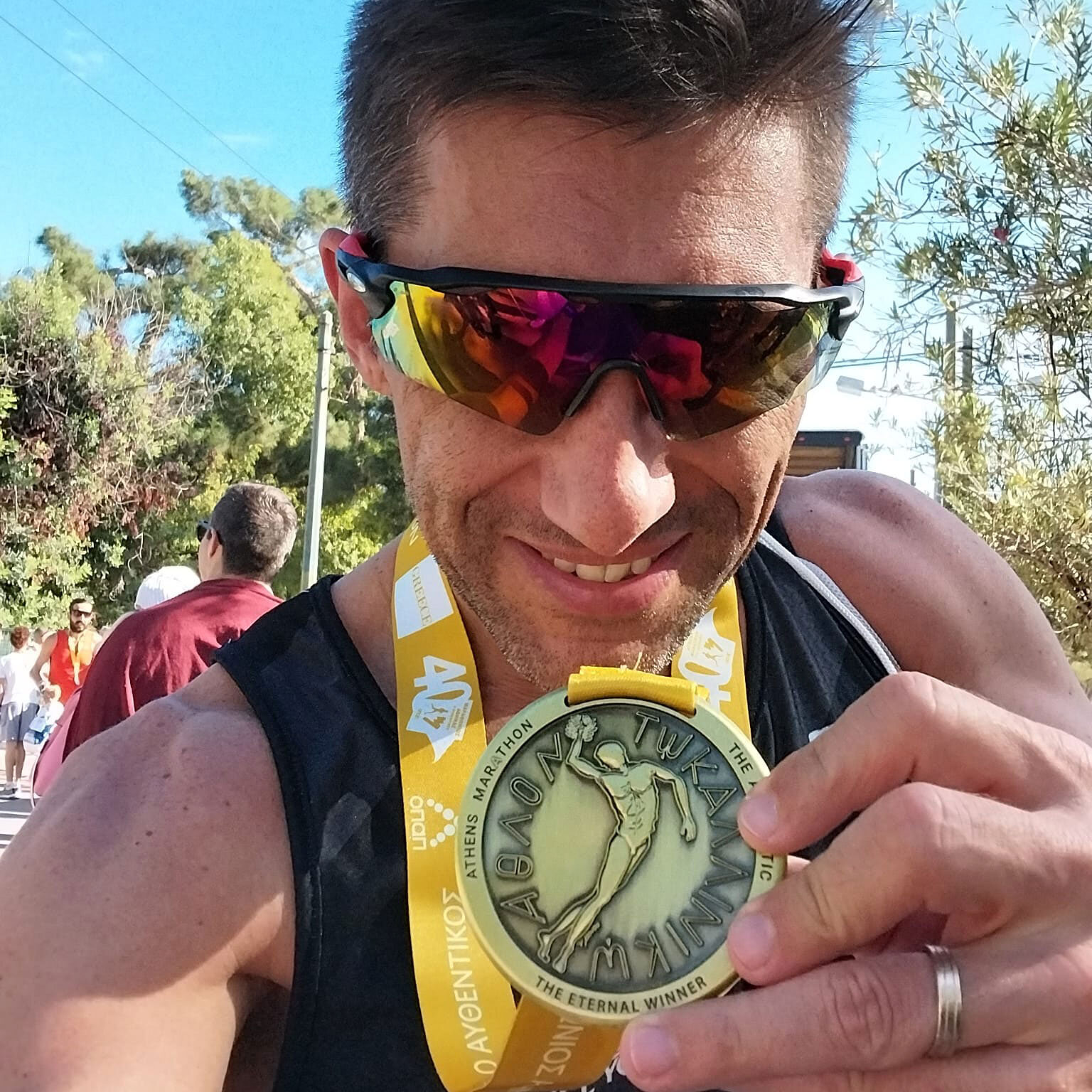
Athenians experience the celebration of the race with joy and tremendous pride. They feel very lucky to be the origin of the authentic marathon; they like to puff out their chests and remind everyone that they are the cradle of the classic marathon, ‘the authentic’, as it appears on all the official event posters and advertising, and is even engraved on the finisher medal (see photo).
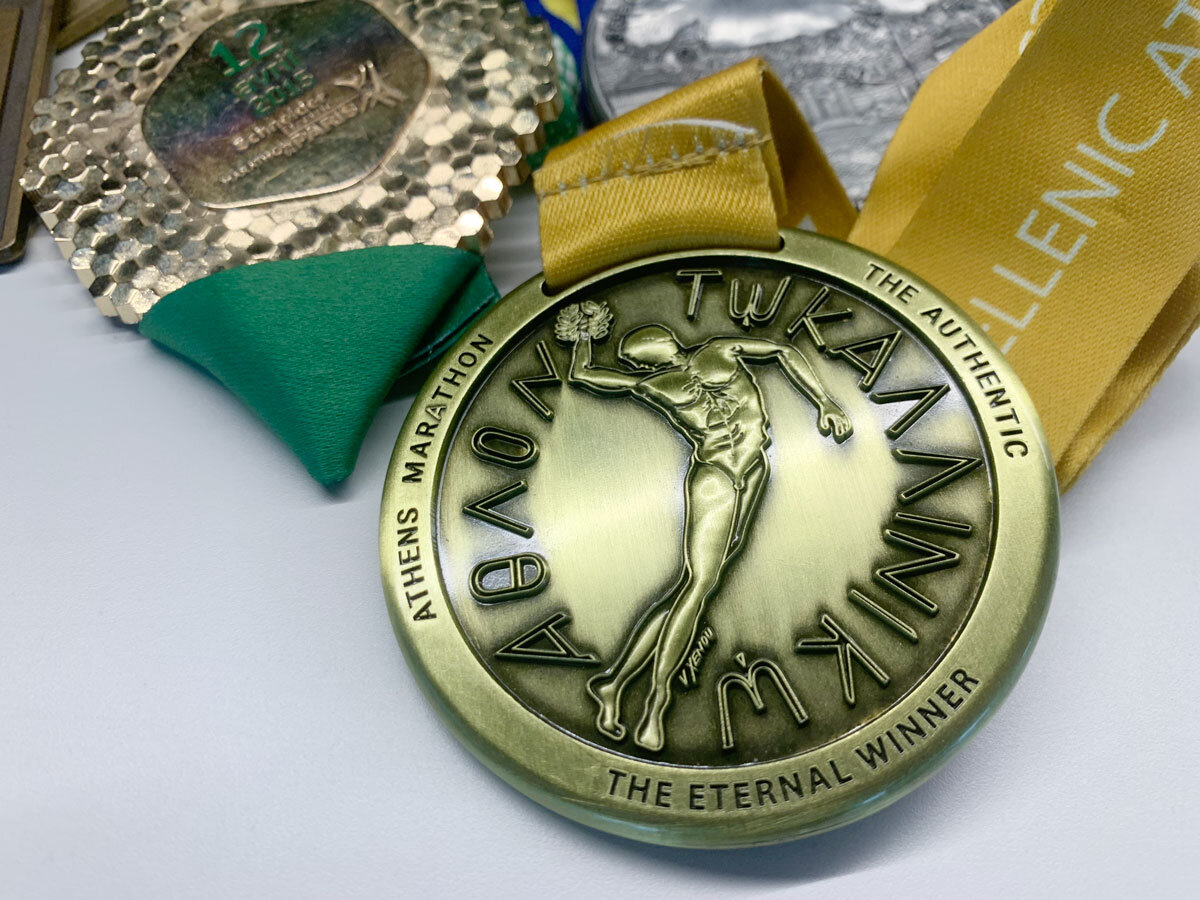
The first Olympic marathon was held in 1896 (one year before the Boston Marathon) on the occasion of the celebration in Athens of the first modern Olympic Games.
History tells us that Pierre de Coubertin, who was the creator of the modern Olympic Games with the idea of commemorating the ancient Olympic Games (held between 776 BC and 393 AD), received the suggestion to hold a long-distance race inspired by the legend of the warrior-messenger Pheidippides, who ran from Marathon to Athens to report, just before dying, that the Greeks had defeated the invading Persian army at the Battle of Marathon.
The great atmosphere experienced in Athens extends to the spectacular runner expo held for the race. I have been to numerous runner expos at major marathons and I can assure you that the Athens Marathon expo is one of the most impressive. It is set up at the Faliro Sports Complex, a magnificent sports facility that hosted handball, taekwondo, and volleyball competitions during the 2004 Olympic Games.
It is an expo where you can spend hours and hours visiting stands from countless sports brands offering clothing, accessories, gadgets… and where many other marathons also exhibit to attract participants, aware of the very high percentage of runners from all corners of the world who gather in Athens.
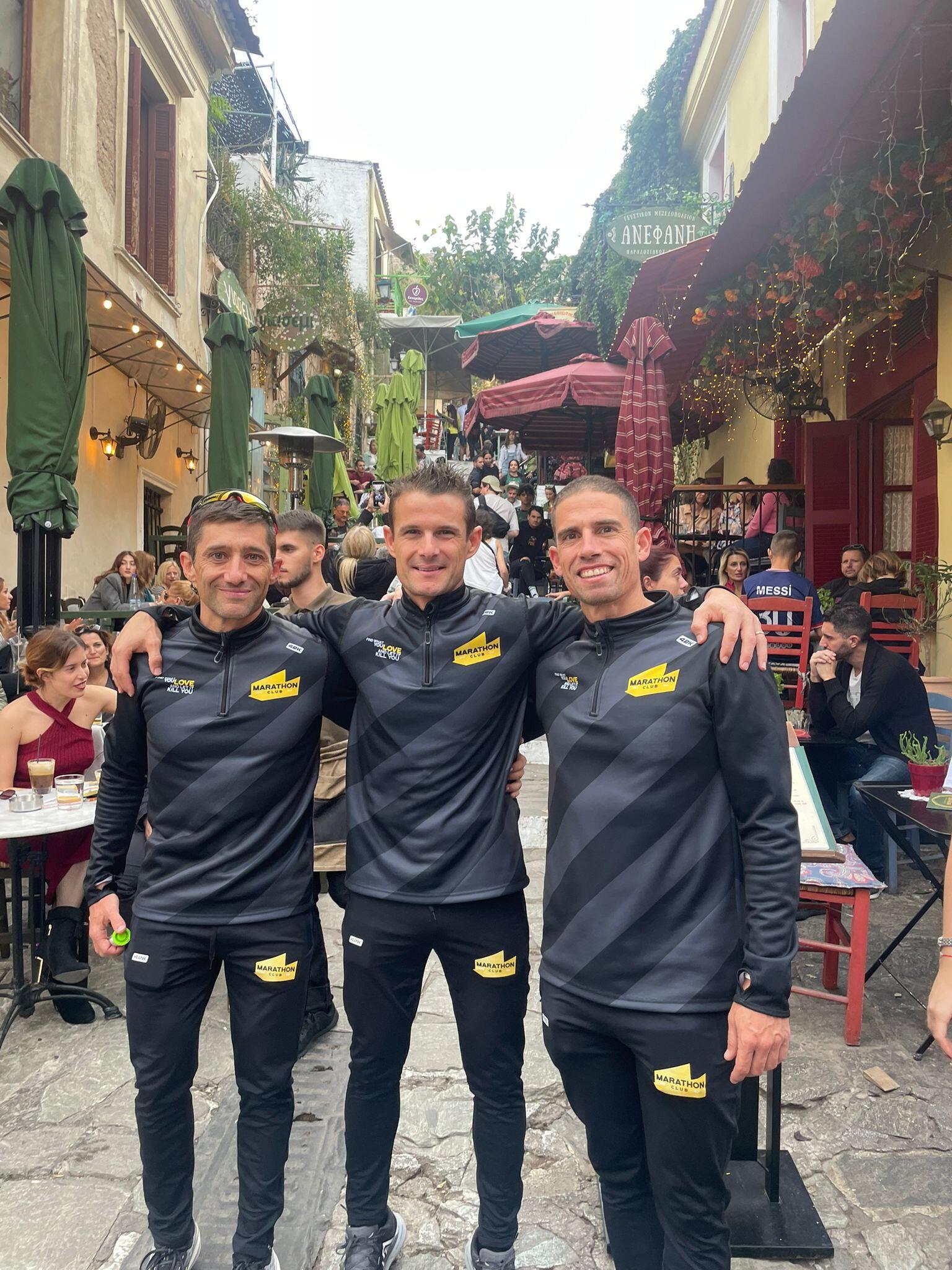
Amazing and impeccable organization
Race day starts with an early wake-up call. You need to set your alarm very early to catch one of the hundreds of buses that take you to the starting line.
The operation of hundreds and hundreds of buses that transport twenty-something thousand runners from Athens to the start in the town of Marathon (marathon is the Greek word for fennel, a plant that was abundant in the area), which is located about 40 kilometers away (the distance that according to legend Pheidippides covered in the opposite direction), is absolutely impressive.
From 5:30 AM onward, the streets of Athens are buzzing with people and buses. It is a massive deployment of buses, perfectly distributed across different areas of Athens and with previously established departure times.
I have worked in race organization and I know the difficulties involved in organizing an event for more than twenty thousand people. It is very difficult to imagine the extraordinary complexity of organizing bus transportation from Athens to Marathon for more than twenty thousand people and doing it with such professionalism and in such a smooth manner.
I must admit that I did not expect to find a race with such a professional and efficient organizational level; everything, absolutely everything, is perfectly organized so that by around 7 AM, two hours before the start, all participants are already in the town of Marathon.
Another example of perfect organization is the baggage check set up at the start. A huge team of organizers handles the collection of participants’ bags and backpacks, which are immediately transported by trucks to the finish line in Athens, where numerous volunteers sort them by race bibs to facilitate collection after the race.
The start in Marathon, a moment of great emotion, excitement, and nerves
We arrived in the town of Marathon at 7 AM and there were still two hours until the start. The atmosphere in Marathon is spectacular: a mix of emotion, excitement, and nerves. And that feeling grows as the start time approaches. There’s hardly any crowd, but it’s not missed because the event’s entertainment team generates huge anticipation and creates an atmosphere of great emotion.
I had the chance to talk to runners of different nationalities who were also debuting in the race, most with many marathons under their belts, and they all admitted to feeling a special emotion, a mix of feelings they hadn’t experienced at the starts of other major marathons.
As the start time approaches, the organization’s entertainment doesn’t stop encouraging the participants. The moments just before the start give you goosebumps.
A unique route due to its toughness and demands
I had studied the route thoroughly and knew I was facing a complicated and very demanding course. And so it was. Without a doubt, it was the toughest marathon I’ve ever run.
The first 10 kilometres are flat and easily completed, but from there the real Athens Marathon begins. I remember being behind two Greek runners from the start who, upon reaching kilometre 10, high-fived and wished each other luck; they knew, surely because they weren’t debutants like me, exactly when it was time to start gritting their teeth to face the race.
When you leave kilometre 10 behind, the road points towards the sky. Until kilometre 31, the terrain is a constant climb, with the occasional short downhill section that deceptively allows for recovery (maintaining a pace or a controlled heart rate becomes an impossible task). There’s a five-kilometre stretch that’s especially tough, from 26 to 31, with very demanding slopes that force you to pace yourself correctly because it’s very easy to make the mistake of pushing too hard and paying dearly for it later.
From kilometre 32 onwards, the route eases up as the downhill terrain towards Athens begins, but the difficulties haven’t ended. To tackle the descent, you need to have very strong quadriceps, otherwise you could have a very hard time in the last ten kilometres.
Between 34 and 36, you start to notice significant muscle fatigue, which is the result of so many kilometres of climbing and the change in foot strikes required for the descent. At that point in the race, you’re very grateful for having done specific strength work for this event.
The last few kilometres can be torturous, very torturous, without proper muscle preparation. In the Athens Marathon, the famous wall can be higher and more dangerous than in any other 42-kilometre race.
The Athens Marathon requires special preparation
The route approaches 400 metres of cumulative positive elevation gain and 80% of that climb is concentrated between kilometre 10 and 31. It’s a marathon where it’s very hard to find a rhythm, except in the first ten kilometres. There are sections of the route with very steep slopes that require a special level of physical and psychological preparation.
In my opinion, the Athens Marathon cannot be approached with the same preparation strategy as a flat marathon like, for example, Valencia or Seville. Without a doubt, you need to arrive with a very significant volume of kilometres in your legs, but I dare say that might not be enough to guarantee crossing the finish line in Athens. This race demands special muscle strength preparation and also extensive prior experience at the marathon distance.
Without a very well-planned strength workout focused on the toughness of this race, the Athens Marathon cannot be tackled safely. If you have any muscular weakness, it can be very difficult to finish.
Emotion overflows upon arriving at the Panathenaic Stadium in Athens
If I had to keep one unforgettable memory of the Athens Marathon, it is without a doubt entering the Panathenaic Stadium in Athens.
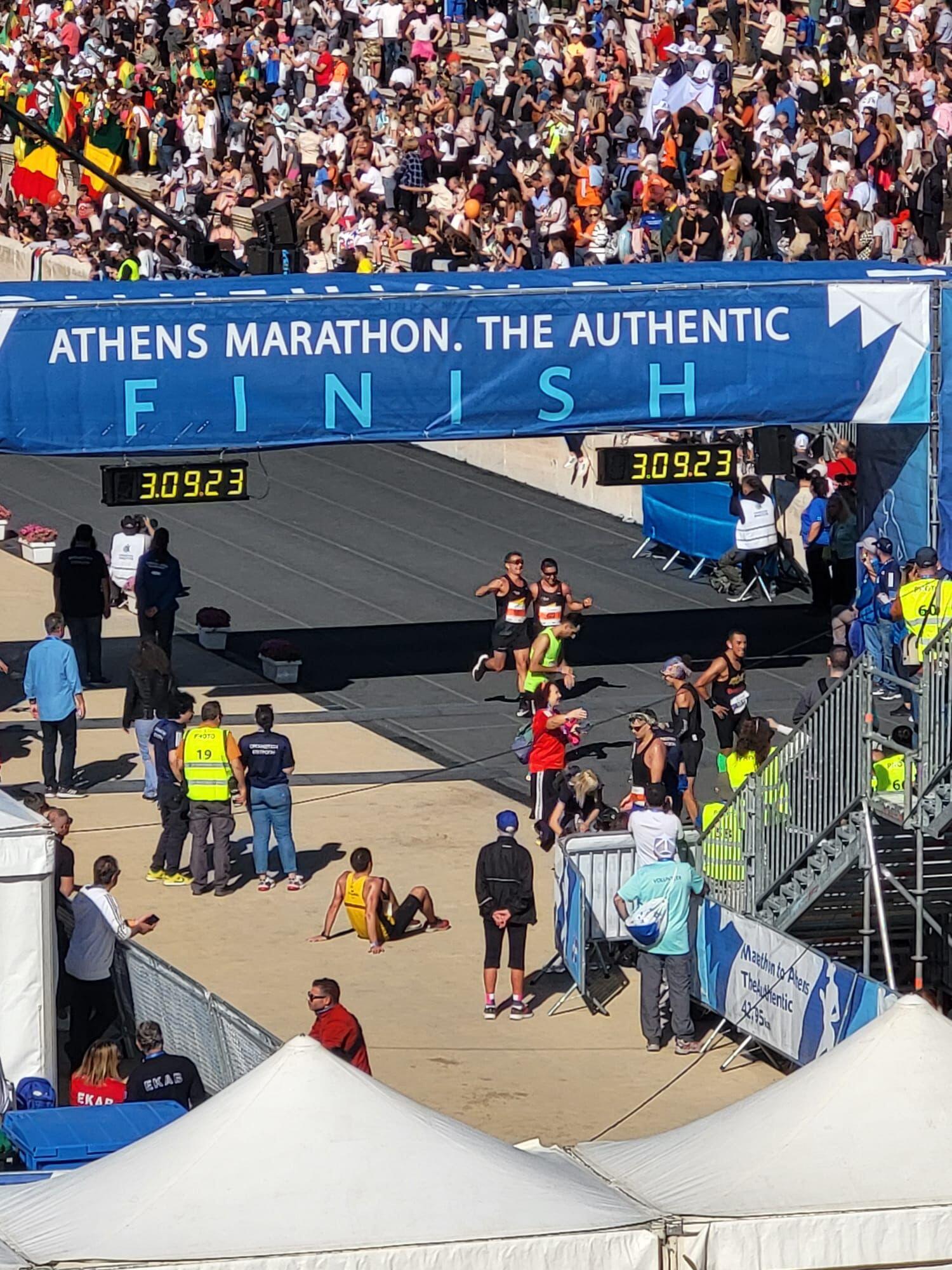
At kilometre 42, there’s a curve that puts you on the home straight into the stadium. At that moment, your senses aren’t able to process everything you see and hear. Emotion overflows. Suddenly you find yourself running inside the most legendary stadium in sport. The stands are incredibly high and full of people clapping, cheering, shouting… You look up and feel overwhelmed by the spectacle. No matter how you’ve imagined that moment: the reality exceeds any expectation.
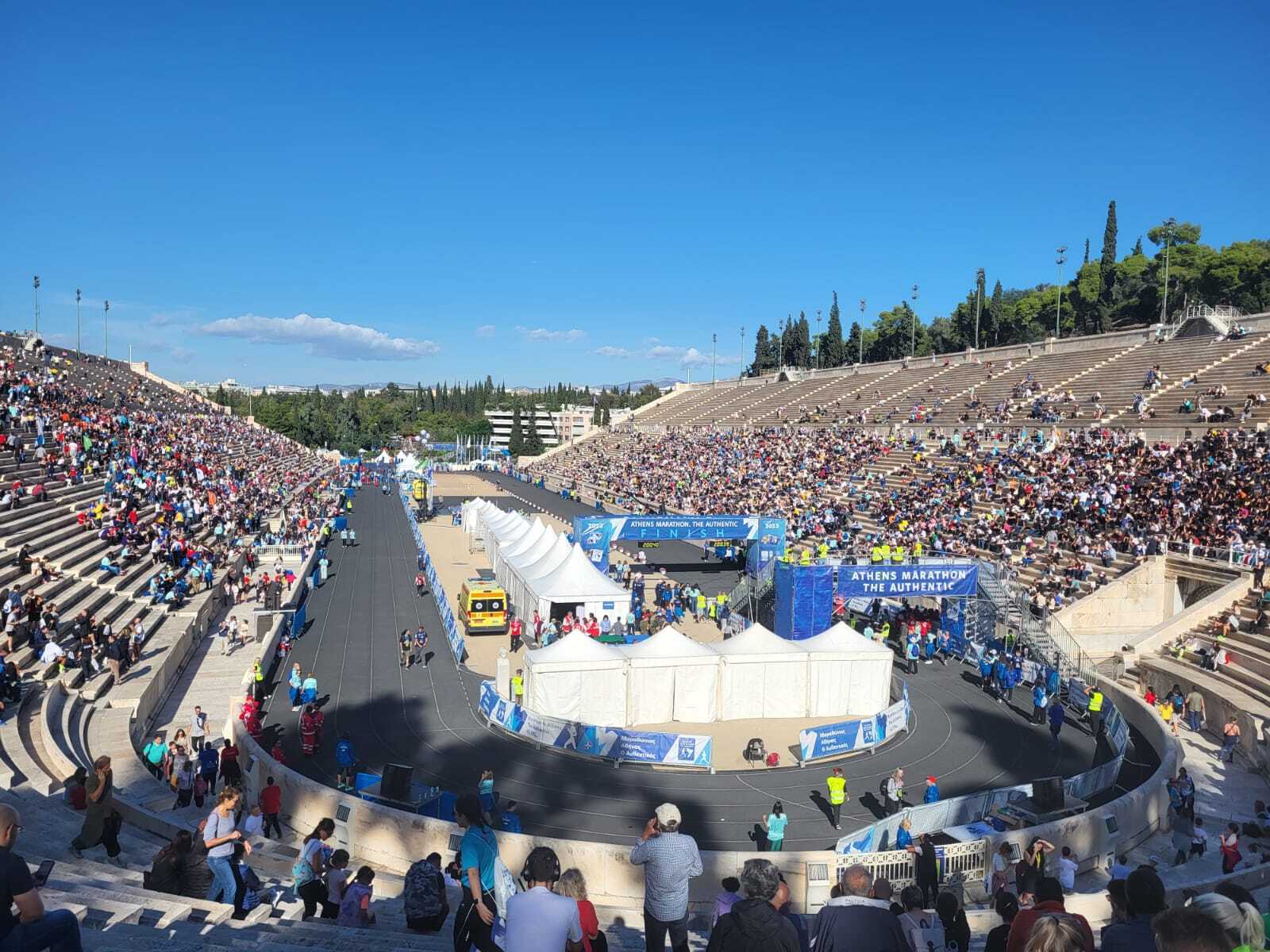
The Panathenaic Stadium, also known as the Kallimarmaro (which in Greek means “beautiful marble” because it’s built with white marble), hosted the first edition of the modern Olympic Games in 1896 after being rebuilt on the remains of an ancient stadium dating back to 329 BC.
It’s located in the centre of Athens and you reach it after a triumphant 2-kilometre stretch through the city streets. The number of people waiting in Athens for the participants to arrive is immeasurable. The emotion you feel in those two kilometres neutralizes any feeling of tiredness, any discomfort. Everything you’ve suffered is compensated for. The warmth of the Athenian public is impressive and how they cheer to carry you on their wings to the stadium entrance.
Athens is a different marathon from other major marathons
The Athens Marathon is different from other major marathons in many ways. It has numerous peculiarities that make it unique and some of them, in my opinion, reinforce its singularity and authenticity.
At first glance, it might seem less attractive because it has a series of “drawbacks” that don’t occur in other major marathons: the huge early wake-up call on race day, the nearly one-hour journey to Marathon, a route with more than 20 kilometres of uphill terrain (the longest uphill in a marathon event), or running without a crowd for most of the race.
In any major marathon, the presence of a crowd along the entire route is common, but in the Athens Marathon, it’s not like that. There’s a crowd at the beginning, at the start in Marathon, but as soon as you leave this town and head for Athens, the race runs along a kind of national road without a crowd, except when passing through villages like Nea Makri, Rafina, Pikermi… where all the inhabitants take to the streets to cheer with great enthusiasm, offering olive branches as a way of wishing good luck, dancing Sirtaki, which is the quintessential Greek folk dance…
The crowd is concentrated in the towns the race passes through and at the end, in Athens, but there’s almost 80 percent of the route where you run without a crowd. Perhaps that might seem strange or be a drawback for someone used to running marathons with entertainment at every kilometre and a crowd present along the entire course; to me, it seems that running alone for so many kilometres gives this race a special appeal.
The Athens Marathon forces you to face the true solitude of the marathoner, the famous solitude of the long-distance runner. The marathon is a sporting event that demands mental strength, and on a route like the Athens Marathon, you test your mental strength like in no other marathon, at least like no other I’ve run.
Abel Antón and Martín Fiz’s times at the 1997 World Championships, a feat
After having run the Athens Marathon and suffered its toughness and demands, I consider the times set by Abel Antón and Martín Fiz at the 1997 Athens World Championships, 2h 13m 16s and 2h 13m 21s, to be a real feat, as they became world marathon champion and runner-up.
Antón and Fiz’s records in that world championship are amazing. When you know the route, you give much more value to what they did. It’s a leg-breaking course of brutal demand. It seems almost like science fiction to think about running at such high paces on a course like the Athens Marathon.
In all my marathon participations, I had managed to be sub-3 hours (except in Stockholm in 2018) and I started in Marathon with that ambition, but the race put me in my place. In the end, I stopped the clock at 3h 09m, a time I celebrate with as much excitement as any of my best records (2h37m and 2h42m in Valencia 2013 and Valencia 2012, respectively).
I’ve fulfilled a dream. I’ve ticked off my wishlist what for me has always been the marathon par excellence. I’ve experienced the most emotional finish of my life and I’ve done it accompanied by two great friends, Borja and Carles, with whom I’m united by many races and many kilometres of running, but from now on, we’re also united by having lived the experience of the great Athens Marathon, the authentic one, together.
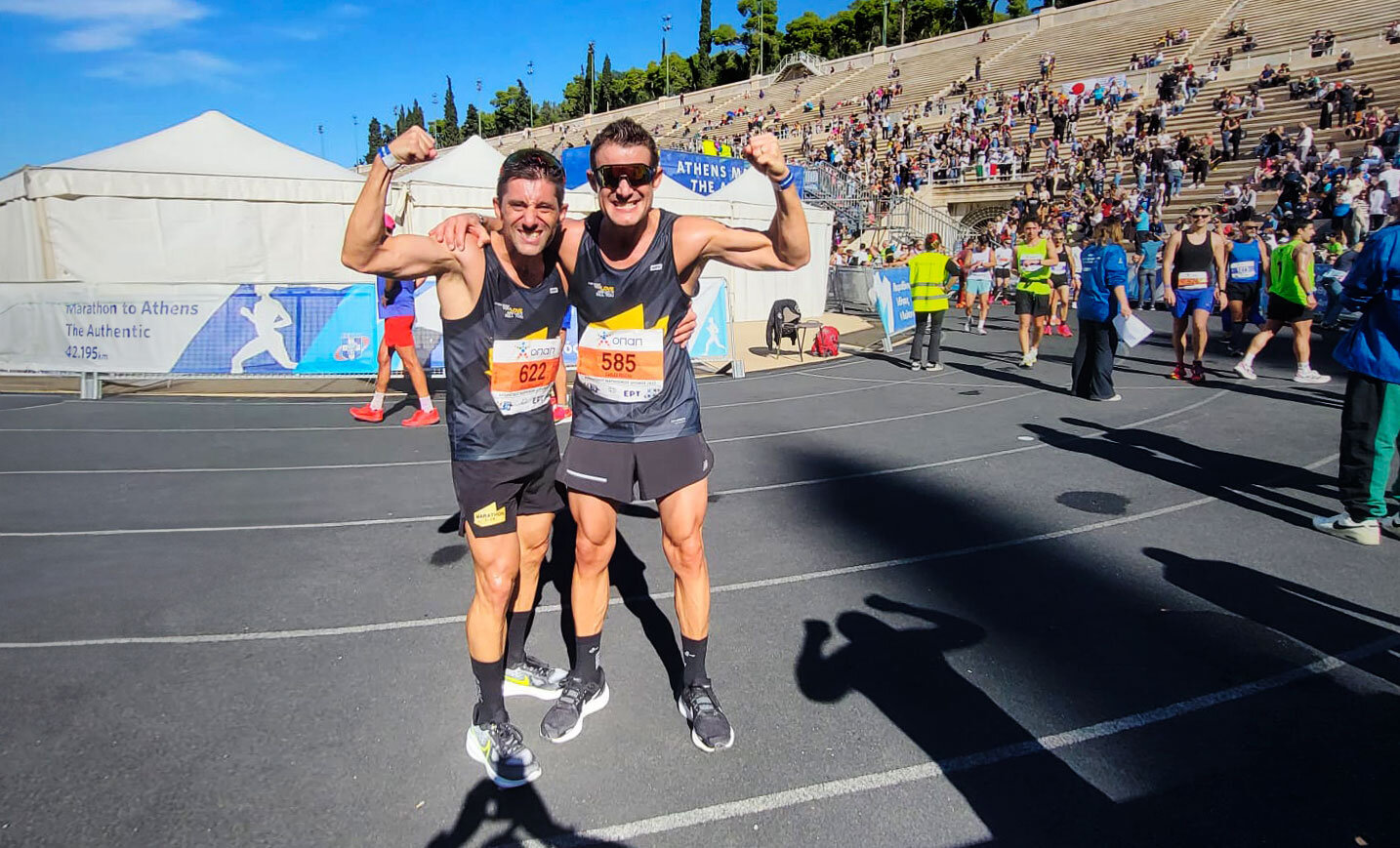
Two other great friends, José Luis and Chema, should have experienced it too, but due to different personal circumstances, they couldn’t. I hope and wish that one day the five of us can line up, as planned in 2023, at the Marathon starting line and face the most historic 42.195 kilometres together. I trust that life will allow me to enjoy the unique experience of running into the Panathenaic Stadium in Athens once again.
I heartily encourage any runner who loves the marathon to dream of competing in the Athens Marathon at least once in their life.


Text for 42K by:
Julio Mas
COO of 42K
Julio Más Lajara is the COO (Chief Operating Officer) of 42K. He is passionate about running (both road and trail) and cycling. He has run 14 marathons and countless long-distance cycling events. He fulfilled his dream of becoming an Ironman in Regesburg (Germany).
Other posts that may interest you.
42K joins CE Colivenc and strengthens its commitment to competitive athletics


42K outfits the Athletics Federation of the Valencian Community




Be the first to comment on this post!