
Subscribe to our newsletter to keep up with all the latest news and promotions, and automatically receive a welcome discount coupon in your email.

General search
42K

Be the first to know with the 42K newsletter!
CUSTOM

Customise your kit with our CUSTOMIZADOR!
CUSTOMISE NOW!
Trying to lose weight during peak season is a bad idea
by Ismael Martínez García
Having a good body composition is essential to achieve or pursue optimal athletic performance. For this reason, many athletes decide to lose weight to fine-tune and improve their sensations in training and competitions.
Now, when is it advisable to try to lose weight? The answer is simple: either before or after facing the competition season. What is not advisable is to undertake a weight loss strategy during the competitive period because it will hardly yield any benefits and, with total certainty, athletic performance will be negatively affected.

Therefore, dieting to try to lose weight during peak season (and thus competing and demanding maximum performance from the body) is a bad idea because it will not bring benefits and, on the contrary, will cause harm.
Losing weight during the season penalizes performance
Depending on the type of sport practiced, one body composition or another will be needed. For example, in sports where strength is paramount, such as weightlifting, a more voluminous physique and great muscular power are needed. In contrast, in endurance sports (such as running, cycling, triathlon, etc.) and endurance with strength (such as football, martial arts, tennis, etc.) a finer and lighter physique is required.
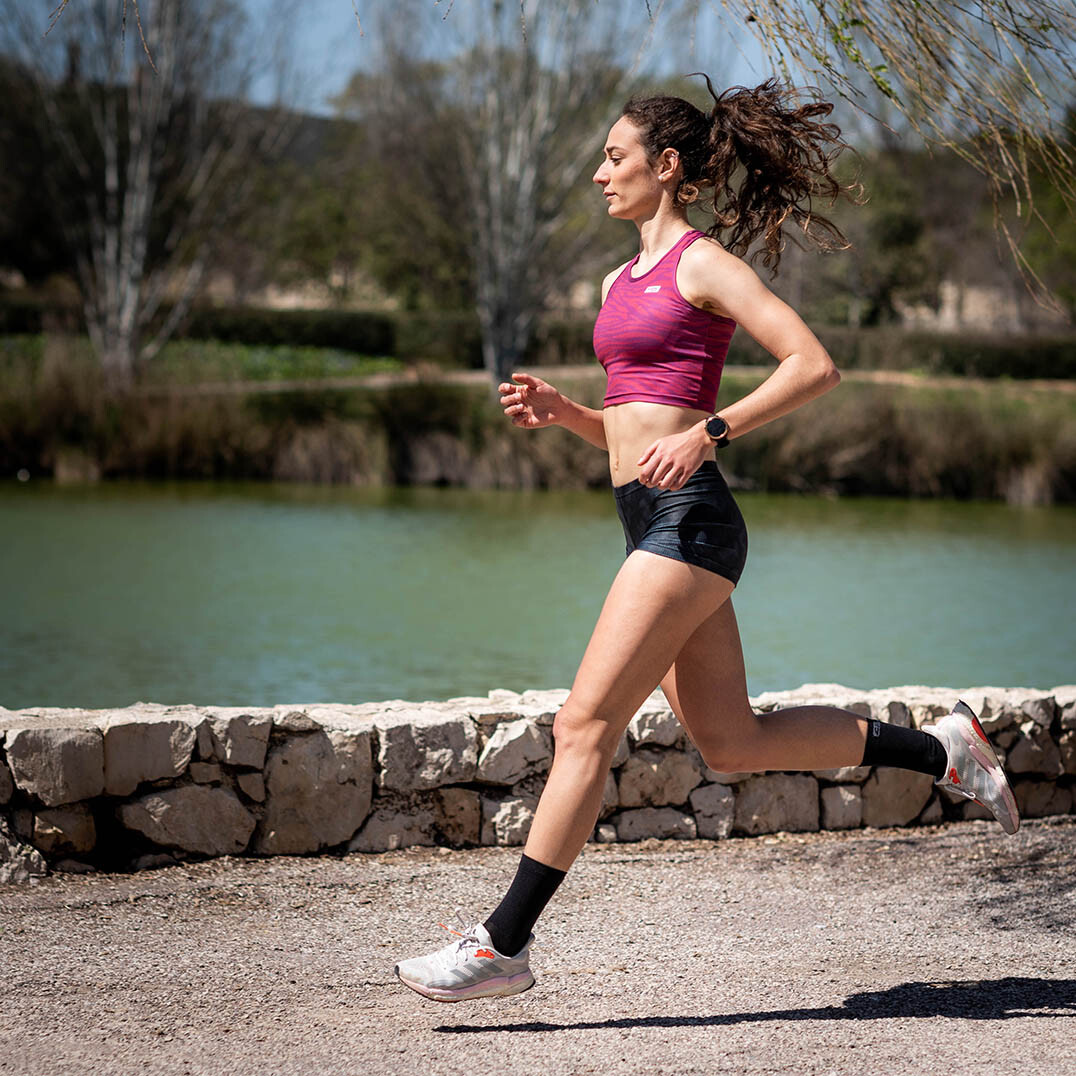
That is, to run a race like a marathon, the lower the athlete’s weight, the less the sensation of “carrying a backpack” that is suffered during the 3-5 hours (in the case of amateur runners) of the race. It is undeniable that body weight affects performance in running (or foot racing, as some prefer to call it) more than in other endurance sports such as cycling or swimming.
Achieving the right or optimal weight can be very beneficial for anyone who runs regularly and has competitive goals such as a half marathon or a marathon or a trail race of a considerable distance. Because with the right or optimal weight, it is possible to achieve better performance and, therefore, increase paces and lower times, but it is also very important because it reduces the risk of muscle and joint injuries and the athlete will suffer less during the competition.
Knowing all the benefits of running at the right weight and not with a few extra kilos, it is not surprising that this improvement in body composition (reducing fat mass and increasing muscle mass) is sought. But is it advisable to start a weight loss treatment at any stage of the season? My answer is emphatic: NO.
A weight loss diet worsens athletic performance
If a weight loss diet is undertaken, it should be done outside the competition season or when we are not undergoing high-demand training.
The reasons why it is not advisable to go on a diet to lose weight during peak season are the following:
- First, trying to lose weight should be ruled out to prevent a decrease in athletic performance. Let’s use an analogy: if a car uses €50 worth of gasoline for a trip but only €30 worth of fuel has been refueled, there comes a point when the car stops. The same thing happens to the athlete: if the diet provides less energy than needed, after 2, 3, or 4 weeks, their performance will begin to suffer and will finally experience a “bonk”; and from that moment on, there will be little that can be done because their body will no longer respond correctly to the demands of the effort.
- Furthermore, between one training session and another, a significant supply of energy and nutrients is needed, which probably cannot be achieved with a low-calorie weight loss treatment. Therefore, the athlete will not arrive fully recovered for the next training session.
- During training and competitions, a constant supply of energy is necessary to maintain performance. If this is not provided, the athlete’s performance gradually decreases.
Losing fat during peak season
But is it possible to lose or reduce fat during peak season? Yes, but trying not to lose weight.
If you want to lose fat during peak season, it is advisable to follow a weight maintenance diet and generate a negative caloric balance (i.e., burn more kilocalories than you consume) by introducing walks of more than an hour daily in a post-absorptive fasted state, meaning after 3 or more hours after eating (the post-absorptive state is the metabolic state that occurs after digestion, when ingested food is no longer the body’s energy source and it relies on stored glycogen).

Therefore, and in summary, the ideal is to carry out a weight loss strategy during the pre-season or after the competitive period has ended, but it is worth insisting that it is not a good idea to lose weight during peak season because the result will be disappointing.
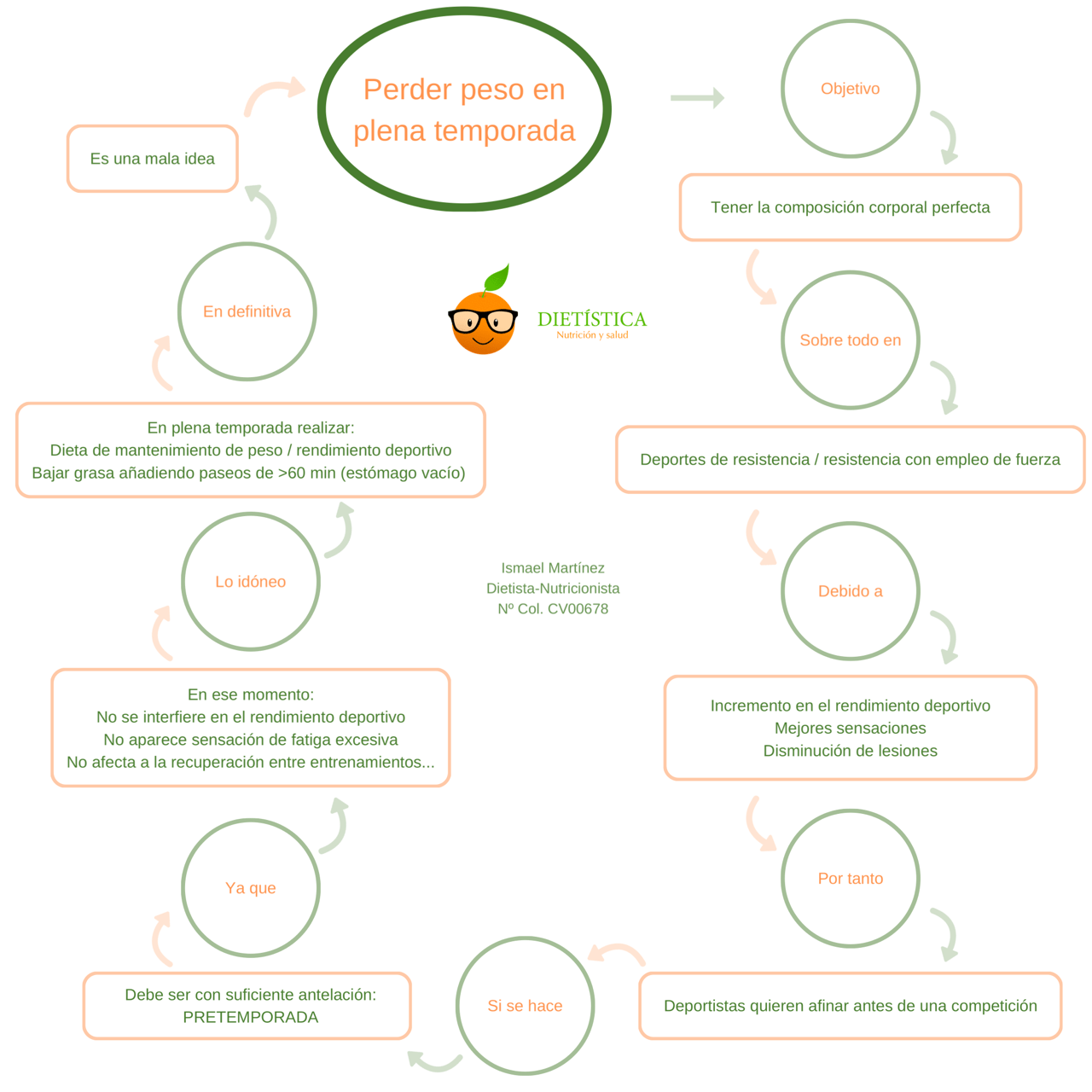
Below you can see a schematic summary of the above explanation in the following infographic.


Text for 42K by:
Ismael Martínez García
Dietista-nutricionista
Dietista – Nutricionista por la Universidad de Valencia. Máster en Nutrición en el rendimiento en deportes de resistencia/ultrarresistencia por la Academia Española de Nutrición. Nº Colegiado CV00678 en el Colegio de Dietistas y Nutricionistas de la Comunidad Valenciana
Other posts by Ismael Martínez García





Be the first to comment on this post!