
Subscribe to our newsletter to keep up with all the latest news and promotions, and automatically receive a welcome discount coupon in your email.

General search
42K

Be the first to know with the 42K newsletter!
CUSTOM

Customise your kit with our CUSTOMIZADOR!
CUSTOMISE NOW!
Is warming up before running necessary? Absolutely, yes. Performing an adequate and good warm-up before running is always beneficial.
In the running world, it’s easy to hear people say, “I don’t waste time warming up; I just start running, and that’s my warm-up.” Not warming up before running is a mistake, especially when the excuse is ‘lack of time’ (10 minutes is enough for a proper general warm-up) or, even worse, ‘because it’s boring’ (it’s much more boring and sad not to be able to run due to an injury that could have been avoided, right?).

Warming up before running will only bring you benefits and no harm (as long as the warm-up exercises are performed correctly).
A good warm-up before running always provides benefits
Runners who don’t prioritize warming up before running may not know what warming up is really for and the benefits it provides.
Before starting an aerobic exercise like running, you need to prepare your body, especially the lower body: feet, ankles, knees, and hips. Warming up before running is vitally important to activate muscles, tendons, and ligaments and perform optimally.
But also, and this is the most important thing, a proper warm-up prevents risks that can range from minor discomfort to serious muscle or joint injuries, including cramps, muscle contractures, muscle tears… In reality, there are numerous risks faced by any runner who ignores or disregards the importance of warming up.
Running, unlike other sports, decisively involves the feet, ankles, and knees in movement—parts of the lower body that are especially susceptible to injuries if subjected to demanding tension and effort from a state of rest or semi-rest without the necessary prior warm-up.
Logically, the warm-up should adapt to each person’s needs and the intensity at which they are going to run; that is, if we are going to run a 5K and the idea is to start ‘strong’ from the beginning or we are going to do a series training, then a different (more intense) warm-up will be necessary than if we are going to do a progressive training where we start at a calm and less demanding pace for our muscles and joints.
Benefits of Warming Up Before Running
Warming up should be part of every runner’s sports routine.
We have already indicated that a good warm-up before running will always provide benefits to any runner, but let’s list the most notable benefits of a good and proper warm-up:
- Prevent injuries thanks to greater muscle and tendon elasticity. There is a varied list of injuries that can occur from not warming up (or doing it incorrectly) and that can interrupt training for a more or less prolonged period: cramps, contractures (cramps may disappear when activity ceases, but a contracture can last for hours or days), muscle tears (due to sudden muscle contraction without the muscle being ready and elastic enough for the effort), joint injuries (sprains, strains…), plantar fasciitis, muscle injuries…
- Increase heart and respiratory rate. This will mean greater blood pumping through the muscles and joints and, therefore, a greater amount of oxygen available.
- Improve flexibility.
- Improve concentration for the planned activity, whether it’s a race or a training session.
What Warm-up Exercises Before Running?
For recreational runners, a good warm-up before running can be based on a routine similar to the one described below:
- Ankle circles. This exercise is performed by resting the tip of your foot on the ground and making gentle rotations in both directions (10-15 seconds with each ankle).
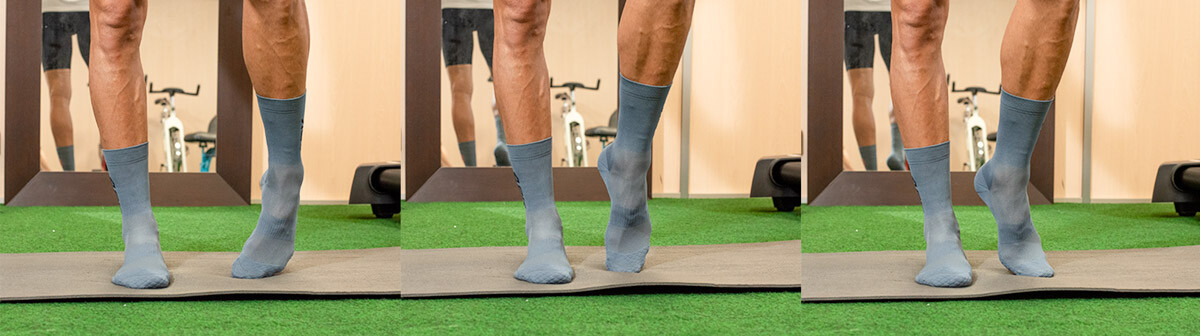
- Hip warm-up. After warming up the ankles, we move on to hip circles. With hands on hips, place your feet hip-width apart, slightly bend your legs, and contract your abdominal area (10-15 seconds in each direction).

- After activating ankles and hips, we do five minutes of light jogging to wake up the muscles.
- Abductor warm-up using quick lateral lunges in both directions (10-15 seconds in each direction).
- Hamstring warm-up using high kicks with a straight leg towards the hand opposite the raised leg (8-10 raises with each leg).
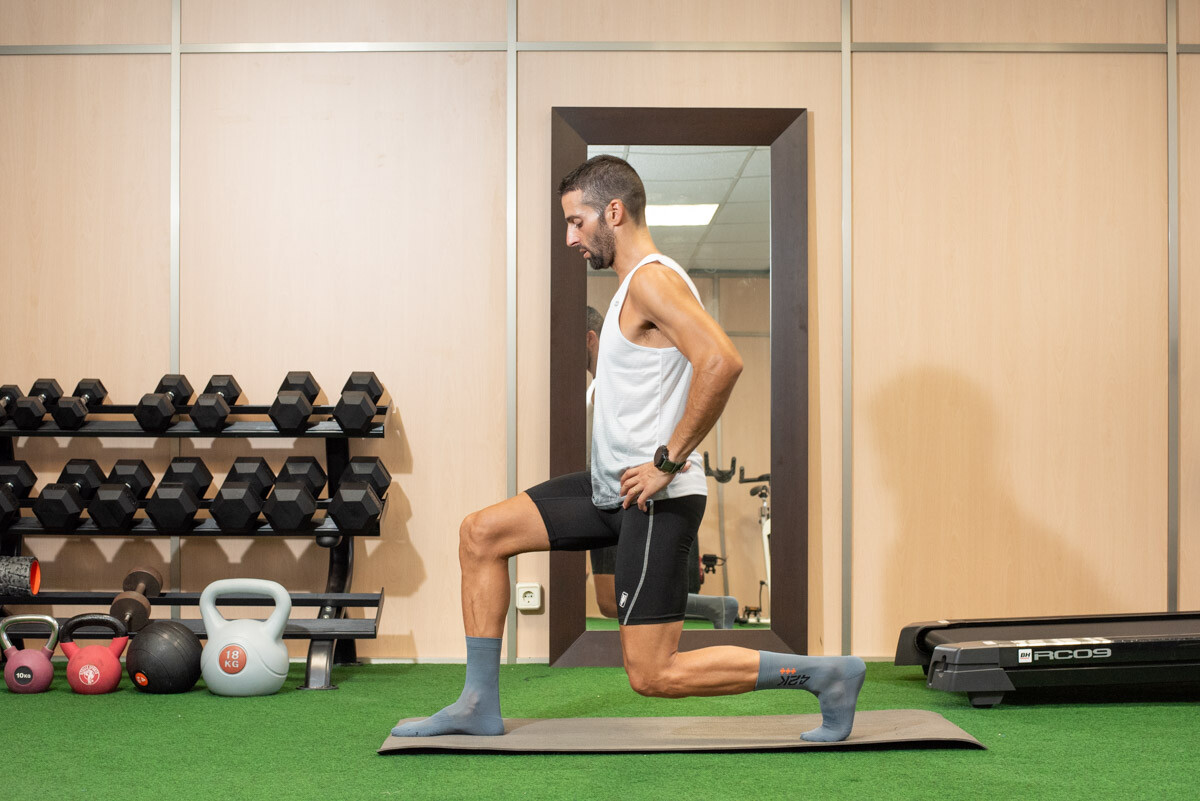
- Quadriceps warm-up using lunges. For the quadriceps lunge, place one foot in front of the other and perform a basic lunge, ensuring your back is straight; with this exercise, in addition to activating the quadriceps, we also activate the hamstrings when standing up (8 with each leg and holding the posture for ten seconds).
- Squats to finish warming up the legs globally and also activate the core (3 sets of 10 repetitions).

- Finally, running in place bringing your heels to your glutes (10-15 seconds).

This is a good example of a warm-up before running. Evidently, the intensity of the warm-up will also depend on the demands of the exercise to be performed.
Do not stretch during the warm-up or before running
In the warm-up before running, we will focus on dynamic mobility exercises because we want to stimulate the muscles’ ability to contract. Stretches aim to relax the muscle (and therefore lead to a loss of its ability to contract), which is precisely the opposite of what a warm-up intends.
Is it good to stretch before running? The answer is no, as muscles and tendons are cold and not ready to withstand the tension required by a stretch and the stress they undergo with this static movement. Stretches should be saved for the end of training or after competition, but never before training or competition.
Some runners perform short sprints as a form of warm-up, and this is highly inadvisable, unless an adequate warm-up has been performed beforehand; doing sprints, even short ones, is very dangerous because it places a very high demand on the muscles and injury can easily occur.


Text for 42K by:
Jaume Albaráñez
Preparador físico
Atleta del equipo CD Metaesport. Cursa estudios de Ciencias de la Actividad Física y el Deporte en la Universitat de València.
Other posts by Jaume Albaráñez
Other posts that may interest you.


Be the first to comment on this post!