
Subscribe to our newsletter to keep up with all the latest news and promotions, and automatically receive a welcome discount coupon in your email.

General search
42K

Be the first to know with the 42K newsletter!
CUSTOM

Customise your kit with our CUSTOMIZADOR!
CUSTOMISE NOW!
Strength training should also include basic strength exercises for the upper body and torso. It’s a mistake not to work the major torso muscles because they’re also necessary to achieve maximum efficiency as a runner. In this article we’ll present 5 basic strength exercises for upper body and torso that are recommended for runners; these are push-ups, rows, shoulder press, bicep curls, and tricep dips.
Coach and fitness trainer Marcos Greus (INEF graduate specializing in high performance) explains in the following article and also through a video how to correctly perform these five basic strength exercises for the upper body. “These are five basic exercises that work all the major muscles of the upper body or what’s also called the upper body,” says Greus.
Basic strength exercises for chest, back, shoulders, and arms
Too often coaches encounter runners who don’t give the importance it truly deserves to upper body strength training. To improve as a runner it’s essential to work strength evenly. It’s a mistake to think that to progress in running it’s enough to do strength work for the legs. The main goal of strength sessions is to gain power and endurance to perform better and prevent injuries.
Strength training is important for the entire population, but it’s fundamental and essential for people who run regularly.
Lower body strength work (legs) should be a priority, but it can’t be isolated; you also need to work the core (abdominals, lower back muscles, and hip muscles) and, of course, also the upper body properly to avoid muscle imbalances.
When starting to run it’s common to have doubts about which basic strength exercises are most suitable. In other articles on this blog there’s information about the main strength exercises for legs and also about basic exercises to work the core, so now we’ll look at the basic strength exercises for the upper body, that is, for the chest, back, shoulders, and arms.
There are many valid exercises to gain strength in the upper body, but I consider it appropriate to recommend those that encompass broad work of the major muscle groups of the upper torso; namely:
- Push-ups to work the chest.
- Rows to work the back.
- Shoulder press to work the deltoids.
- Bicep curls.
- Dips to work the triceps.
These 5 basic strength exercises for the upper body guarantee complete work and are optimal for people starting out in running or who have been running for some time and haven’t yet incorporated strength work into their training.
This video loads from YouTube, which installs marketing cookies.
Any of these exercises can be done at home and we’ll only need resistance bands or elastic bands for strength training (weights can also be used, but it’s advisable not to overuse weights that prevent correct exercise performance).
Basic Strength Exercises for Upper Body: 1. Push-ups
To work the pectoralis major and minor area I recommend using push-ups. This is a basic bodyweight exercise that uses your own weight.
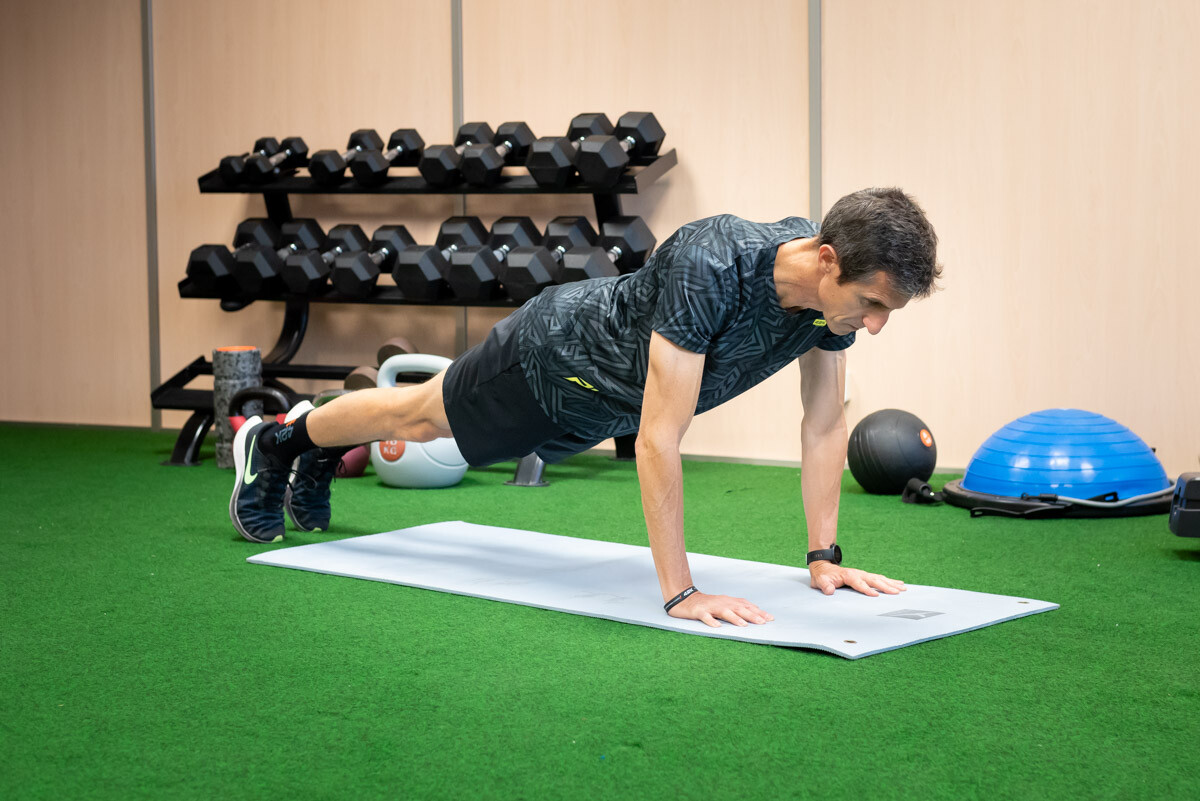
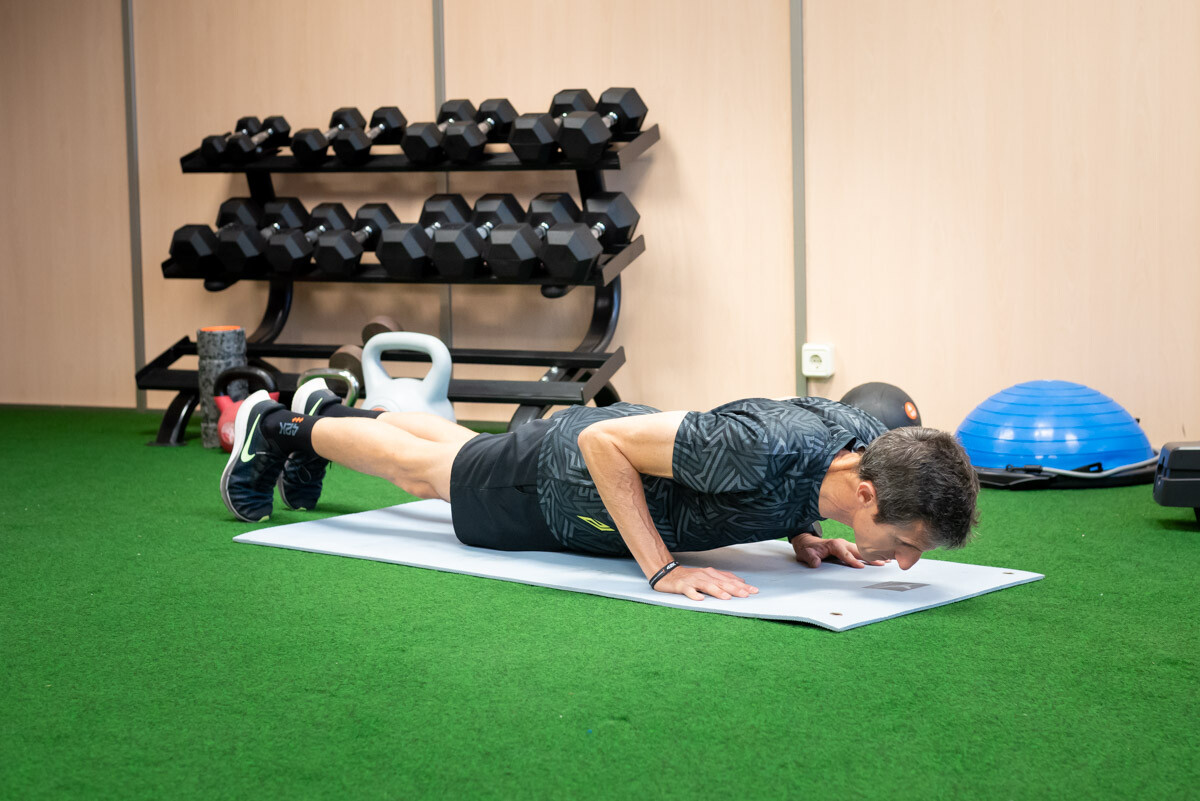
Aspects to consider for correct push-up performance:
- Starting position: lying face down with the torso simulating a plank from head to toe, placing hands with a separation similar to that of the shoulders and below them.
- Contract glutes and abdominal belt before starting the descent.
- Feet together or with minimal separation to keep the glutes under tension.
- In the descent phase (eccentric) the elbows flex backward.
- The chest should not rest or touch the floor.
- Push phase to the starting position with full extension of arms and shoulder.
- The timing of each push-up should be 3 seconds: 1 second to go down, 1 second to hold at the bottom of the descent, and 1 second to go up.
Benefits of push-ups:
- It’s an exercise that activates and works different muscles at the same time, with special strengthening of the chest and arms (biceps and triceps); it also activates the deltoids, abdominals, quadriceps, and glutes.
- Increased strength and power of the upper body.
- Strengthens the spine and the torso in general, which promotes improved body posture.
- Core reinforcement. Push-ups activate the abdominal muscles and back muscles, which in addition to improving back posture also reduces the risk of discomfort or pain that running can cause.
Basic Strength Exercises for Upper Body: 2. Rows
The second of the basic strength exercises for the upper body is the row. Rows work an important part of the back: latissimus dorsi, shoulder girdle, trapezius… For this exercise we can use a resistance band or elastic band for strength training (it can also be done with weights).
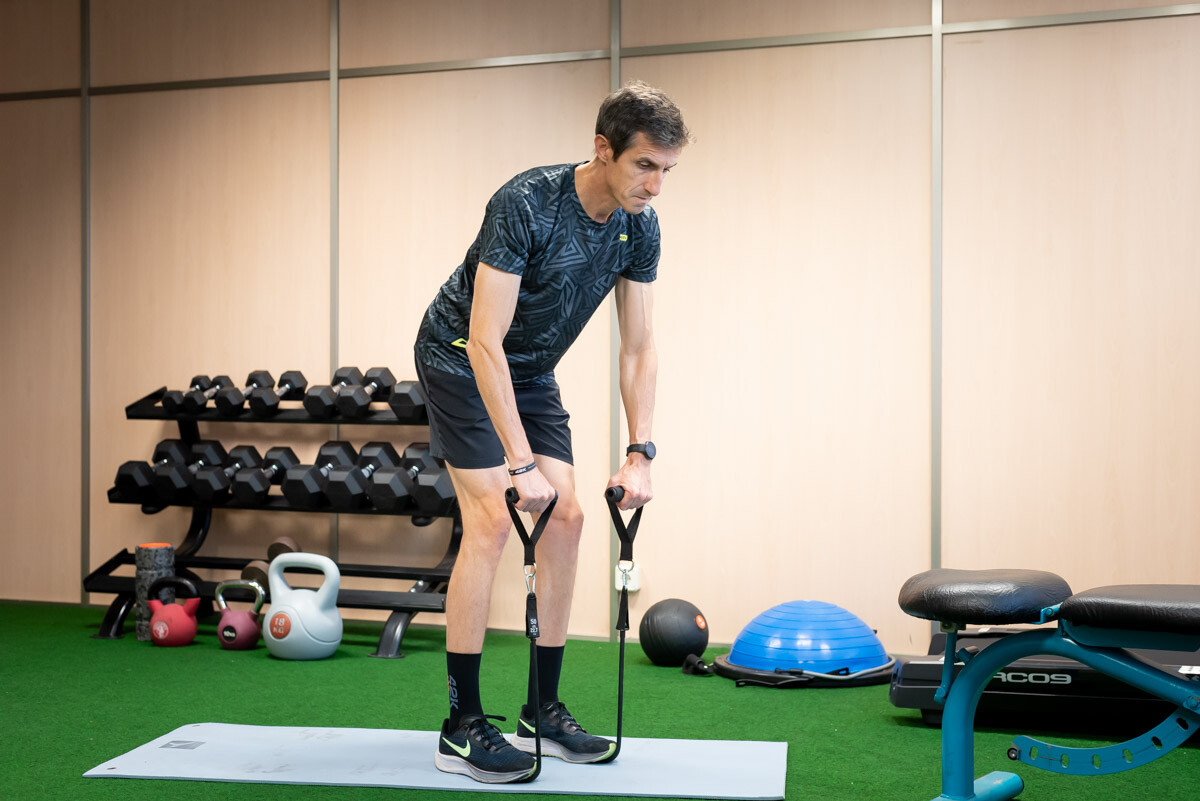
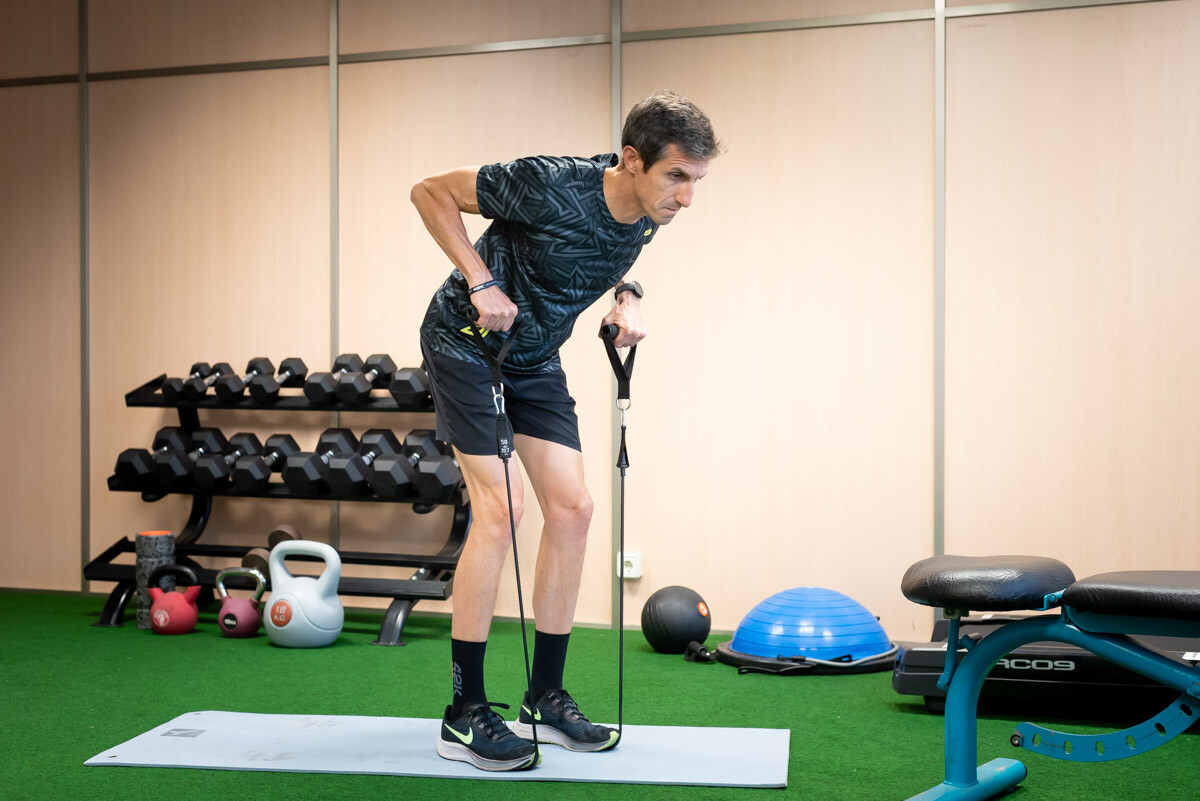
Aspects to consider for correct row performance:
- Starting position: we start from a hip flexion but without curving the back and without having the shoulders forward.
- The arms work close to the body (don’t move them away) and always making movements in a controlled manner.
- The timing of this exercise should be 3 seconds: 1 second when flexing, 1 second holding, and 1 second extending.
Benefits of rows:
- Back strengthening.
- Improved back posture, which undoubtedly helps prevent back pain and possible injuries.
Basic Strength Exercises for Upper Body: 3. Shoulder Press/Military Press
The third of the basic strength exercises for the upper body is the shoulder press or military press. The shoulder press allows us to work the entire deltoid area (both the long, middle, and short head of the deltoid). For this exercise we can use a resistance band or elastic band for strength training and it can also be done with weights; if we use weights we must be careful to use a weight that allows us to perform the exercise correctly without imbalances and without needing to bend or tilt the back. Using inappropriate weights because they’re excessive can be dangerous in most exercises, but especially in the shoulder press because it will force us to make sudden movements that can be dangerous.
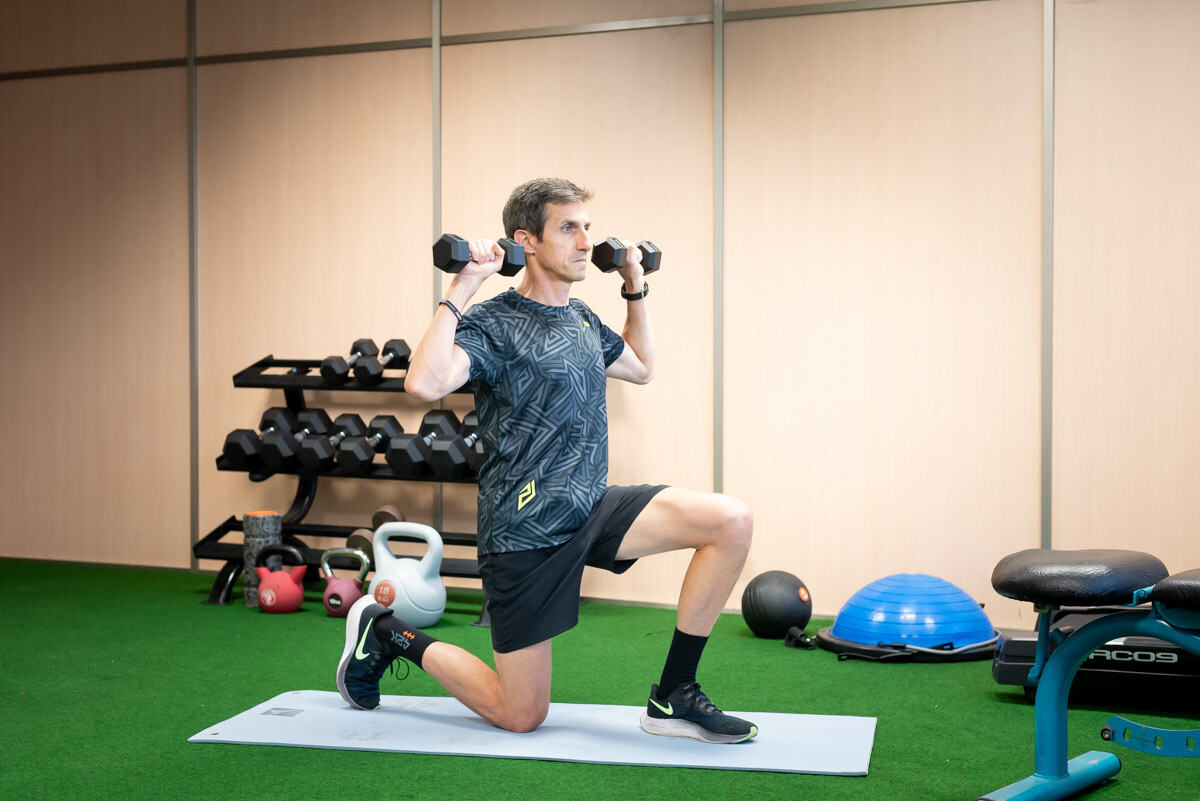
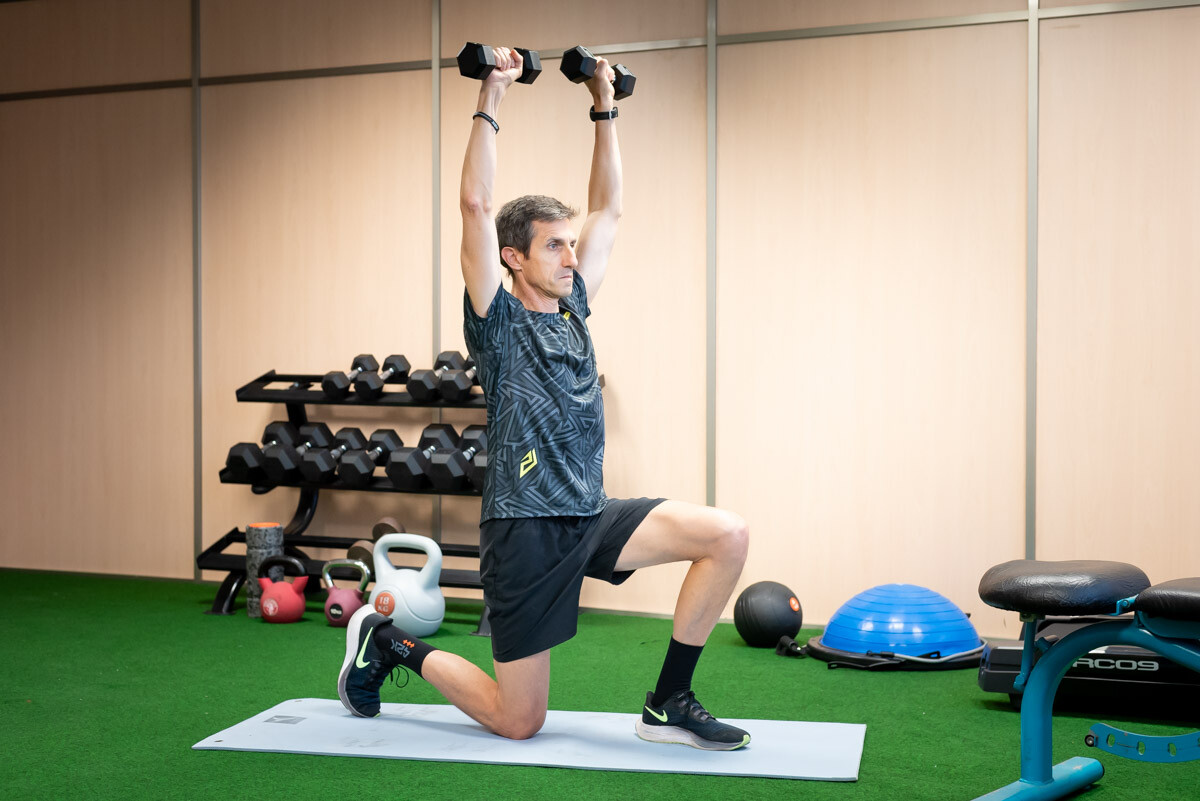
Aspects to consider for correct shoulder press/military press performance:
- Starting position: with the back perfectly straight we’ll place our hands at shoulder height making sure the hands are positioned with palms facing forward on the sides of the body.
- The elevation must be performed so that the hands are vertical over the shoulders.
- Always use appropriate resistance (if we use elastic bands) or weights (in the case of using dumbbells) and don’t work by forcing this muscle group.
- Make good use of breathing: inhale when raising and exhale on the descent.
- The timing of this exercise should be 3 seconds: 1 second when raising the arms, 1 second holding, and 1 second descending.
Benefits of shoulder press:
- Shoulder strengthening, very important muscles for arm stability.
- Increased muscle strength and bone density.
- Improved body coordination and arm stability for everyday actions.
Basic Strength Exercises for Upper Body: 4. Bicep Curls
The fourth of the basic strength exercises for the upper body is the bicep curl. There are many exercises that will allow us to work the biceps but we’ll use the simplest and most classic which is the bicep curl.
To improve as a runner it’s necessary to strengthen the legs but it’s also important to work arm strength, because the arms are decisive for running more efficiently. With strong arms (we’re not thinking about bicep hypertrophy, but having toned arms) you achieve improved running posture and greater balance to improve speed and endurance.
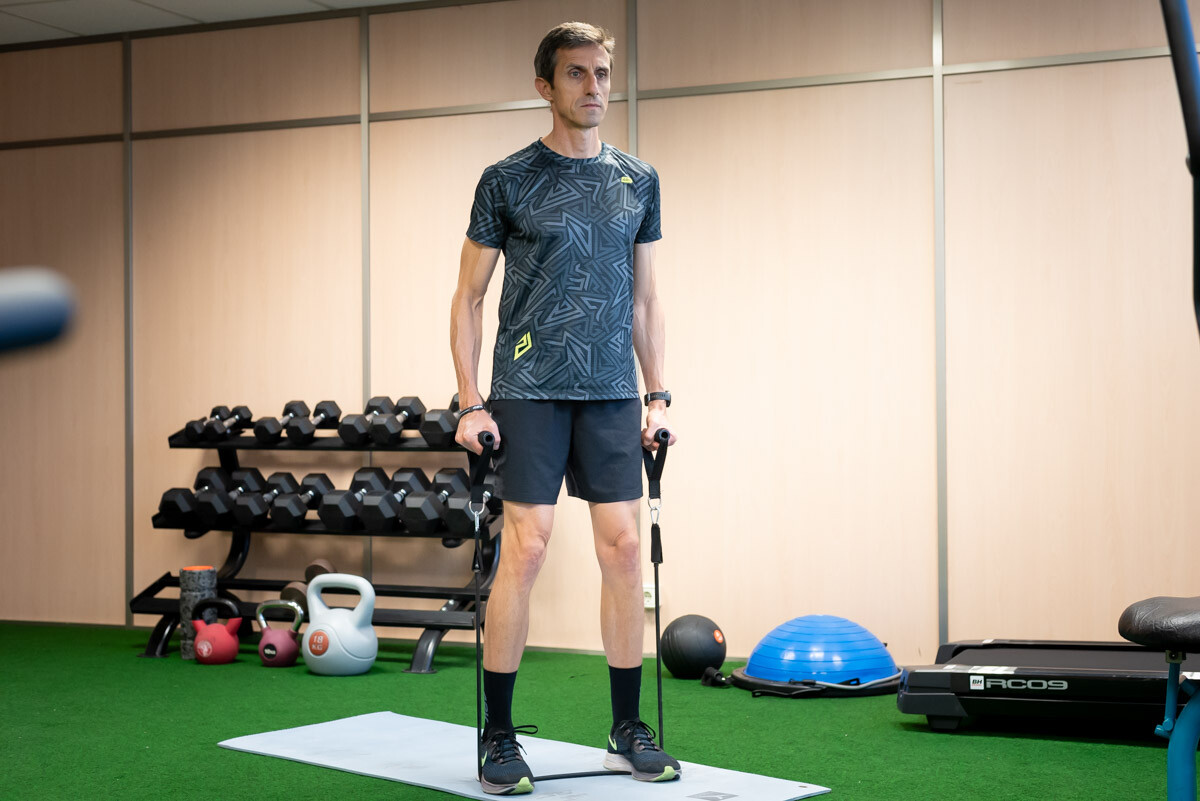
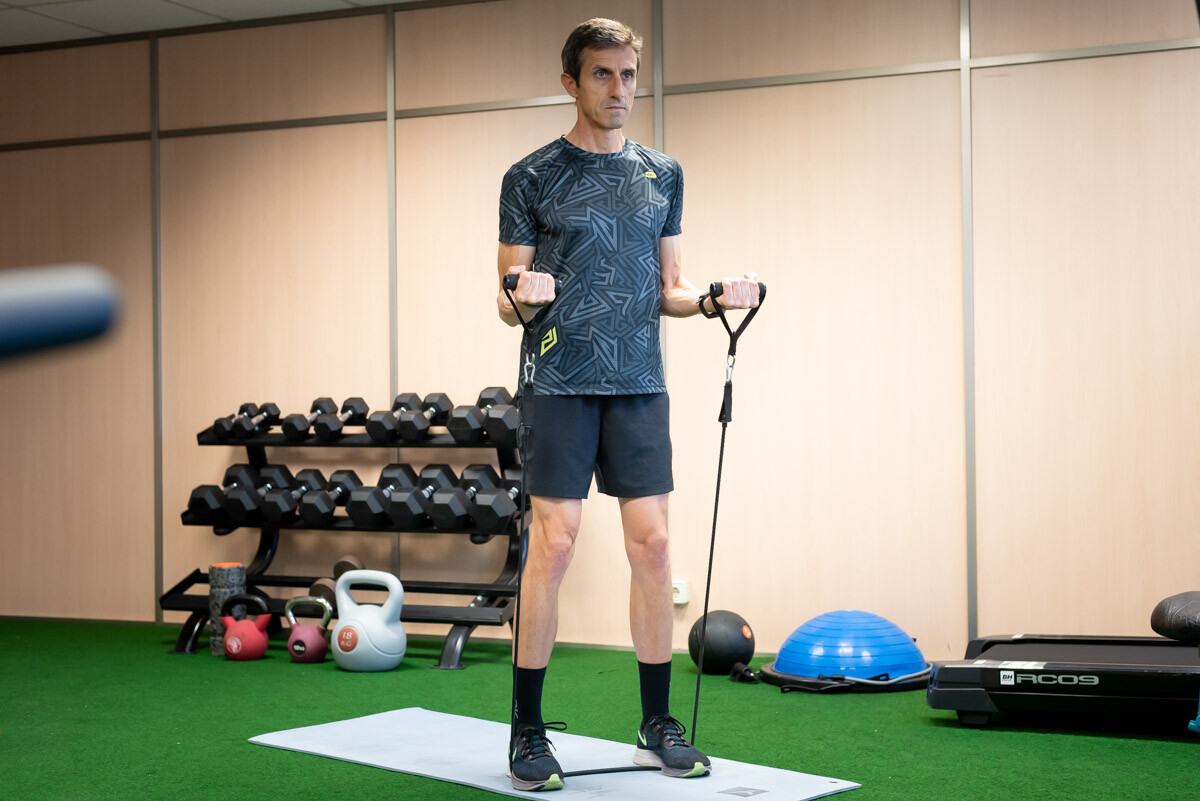

Aspects to consider for correct bicep curl performance:
- Starting position: standing, with a slight semi-flexion in the legs, elbows close to the sides and the back completely straight.
- It can be performed with elastic bands or with two dumbbells (I don’t recommend using a barbell for those starting this exercise). In both cases the exercise can be performed by lifting both arms at the same time or alternately.
- It’s advisable to start with the palms of the hands parallel to the body and make a small turn during the lift while contracting the bicep.
- Make good use of breathing: inhale when lowering and exhale when lifting.
- Try not to sway during the exercise.
- The timing of this exercise should be 3 seconds: 1 second when lifting, 1 second holding, and 1 second descending.
Benefits of bicep curls:
- Increased strength and therefore the ability to perform daily tasks involving lifting and pulling.
- Increased balance and stability when running, as it also involves work of the core stabilizer muscles and legs.
Basic Strength Exercises for Upper Body: 5. Tricep Dips
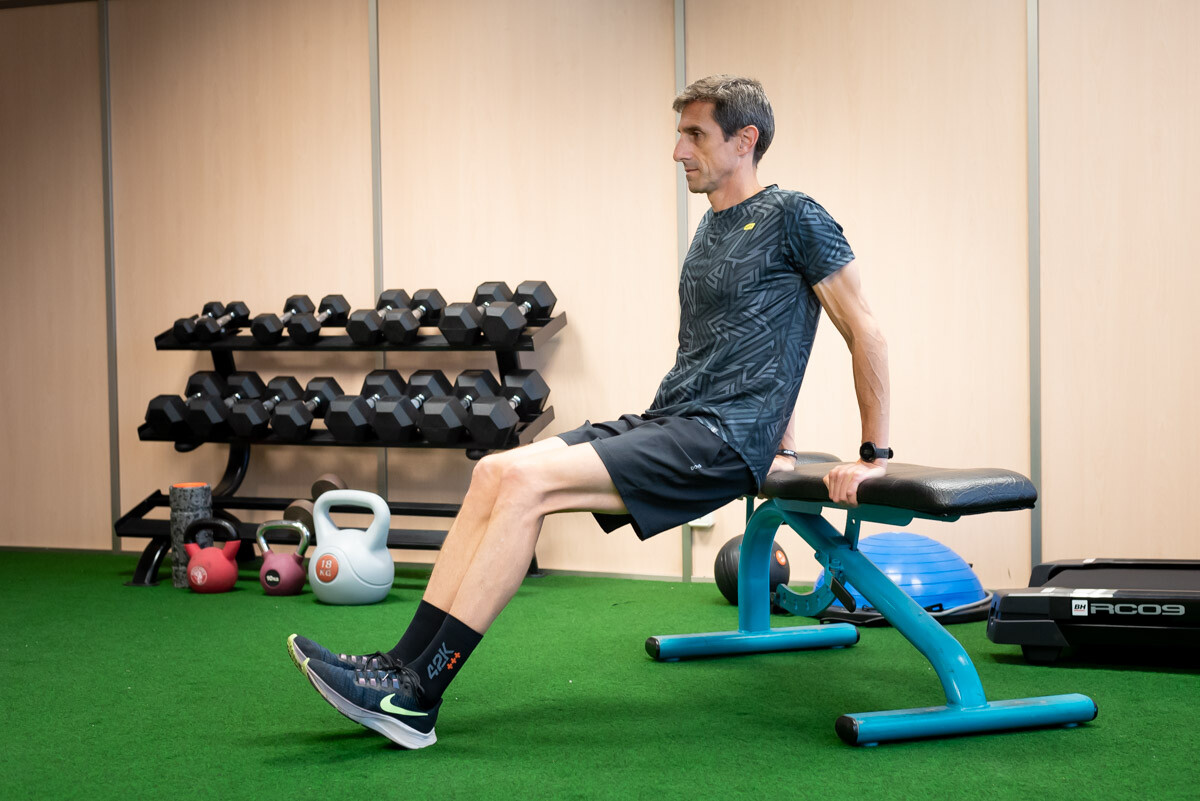
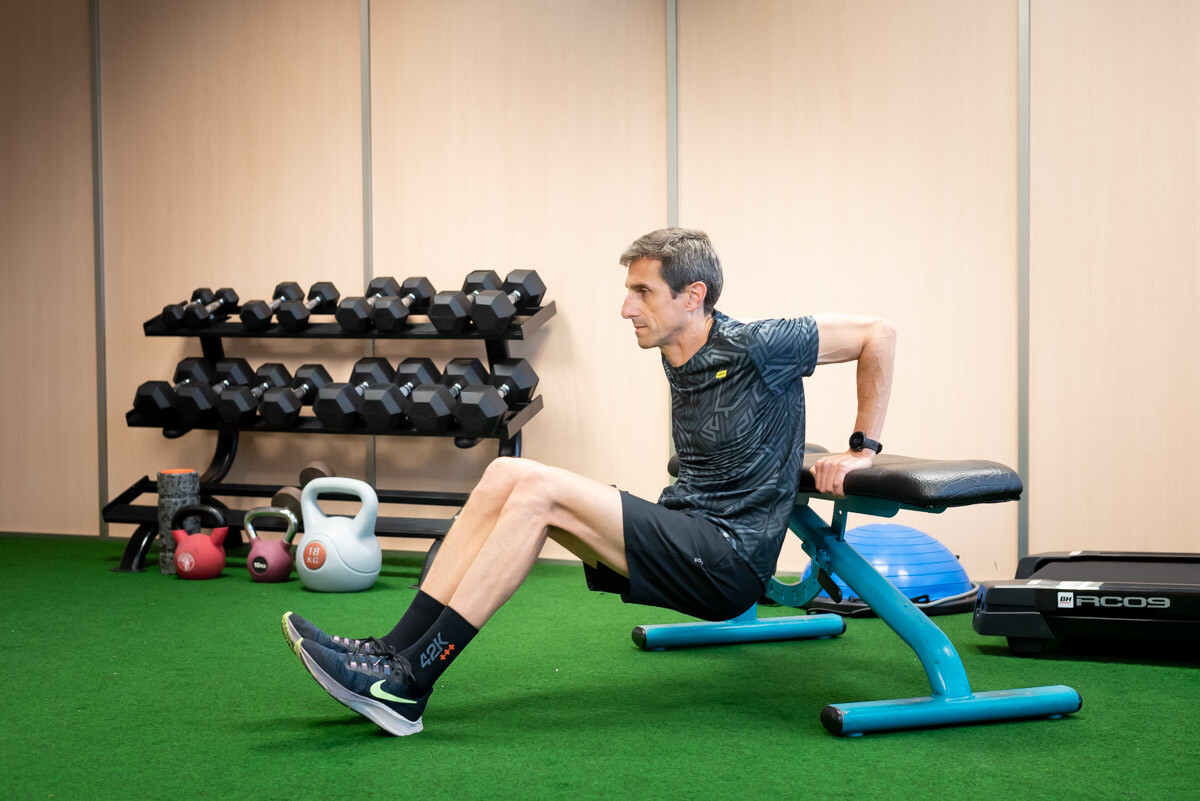
The fifth of the basic strength exercises for the upper body is tricep dips, which like push-ups is a bodyweight exercise (using body weight). This exercise is highly effective and provides many benefits, but it’s perhaps the most demanding of the five basic strength exercises for upper body. It’s very important to do it correctly and as a first step it’s necessary to do a good warm-up beforehand, especially of the shoulders.
Aspects to consider for correct bicep curl performance:
- Starting position: use a bench, chair, or fitball to support your hands, with a separation approximately the width of the shoulders (avoid hand separation that’s too narrow or too wide).
- From the starting position, with arms fully extended, lower the body in a controlled manner until the upper arm is parallel to the floor; from there push up to the starting position.
- Make good use of breathing: inhale when lowering and exhale when lifting.
- Avoid swaying during the exercise.
- Avoid going down too far.
- The timing of this exercise should be 3 seconds: 1 second when lifting, 1 second holding, and 1 second descending.
Benefits of tricep dips:
- Increased strength and joint mobility of the arms.
- Increased balance and stability when running.
- Improved shoulder mobility as it also involves effective work for the deltoids and even the chest.
How to Perform These Basic Strength Exercises for Upper Body?
Now you know how to perform the 5 basic strength exercises for upper body, but how often?
For people starting with strength work, my recommendation would be once a week performing 3 sets of 15 repetitions. In the case of runners who have already done strength work, my recommendation would be to perform these exercises doing 2/3 sets of 20 repetitions twice a week.


Text for 42K by:
Marcos Greus
Entrenador y preparador físico.
Licenciado en Ciencias de la Actividad Física y el Deporte con especialización en deportes de resistencia. Entrenador nacional de triatlón, ciclismo y natación, además de entrenador especialista en larga distancia.
Other posts by Marcos Greus
Other posts that may interest you.


Be the first to comment on this post!