
Subscribe to our newsletter to keep up with all the latest news and promotions, and automatically receive a welcome discount coupon in your email.

General search
42K

Be the first to know with the 42K newsletter!
CUSTOM

Customise your kit with our CUSTOMIZADOR!
CUSTOMISE NOW!
In this article you’ll learn about the 3 basic leg strength exercises that are highly recommended for runners; these are squats, lunges, and bridges.
Coach and fitness trainer Marcos Greus (INEF graduate specialized in high performance) explains how to correctly perform these three basic leg strength exercises. “These are three very beneficial exercises for all runners because they help improve athletic performance and prevent certain injuries,” says Greus.
This video loads from YouTube, which installs marketing cookies.
Squats, Lunges, and Bridges, the 3 Basic Leg Strength Exercises
Many runners who are just starting to run (or have been running for a relatively short time) have questions about which basic leg strength exercises are “essential.”
There are many, countless exercises to build strength in the lower body, but if I had to recommend three, especially for people new to running or who have been running for some time and haven’t yet incorporated strength training into their workouts, they would definitely be these:
- Squats
- Lunges
- Bridges
These 3 basic leg strength exercises are the ones that, at minimum, every runner should include in their weekly training routine because they will help you run more efficiently, delay muscle fatigue, and also reduce the risk of injuries.
I highlight and recommend these three basic leg strength exercises for their effectiveness (they engage all the muscles directly or indirectly involved in running) and because they can be performed at home with your own body weight (after working with body weight for a while, you can start using additional weight like dumbbells, barbells, etc.).
The leg strength training, like core training, is important for the entire population (with efforts adapted to each person’s age and personal circumstances), regardless of whether they play sports or not, but it’s fundamental and essential for runners because, as already mentioned, it helps improve performance and run more efficiently and safely by reducing the possibility of overload, discomfort, and even injuries after a day of intervals or a long run.
Strengthening your legs is essential to enjoy running on any surface, but it’s especially important for running safely in the mountains. Trail runners should pay close attention to leg strength work because running on uneven terrain requires prepared lower body muscles to prevent problems in the ankles, knees, calves, hamstrings…
Basic Leg Strength Exercises: 1. Squat
The squat is an exercise that works all the muscles involved in running: quadriceps, glutes, hamstrings, calves, and soleus.
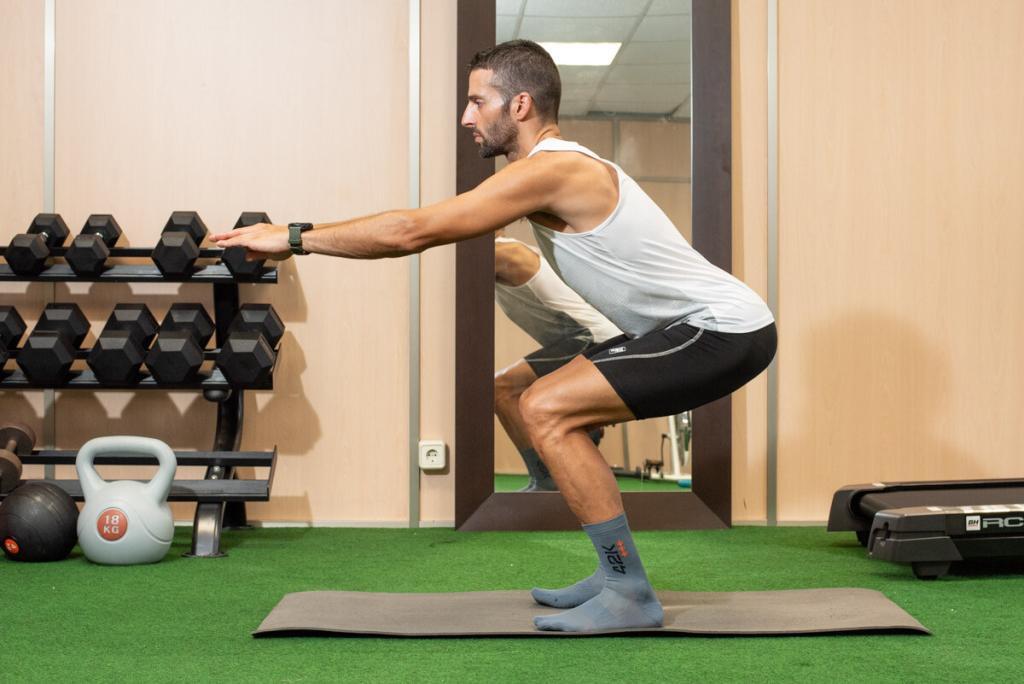
Important things to keep in mind to execute the squat movement correctly: for beginners, it’s recommended that the first few times they perform the exercise with a chair or bench behind them to lower until touching with their glutes (without leaning or sitting).
Another aspect to consider is that you need to perform the descent with a straight back and engaged core so your back doesn’t suffer. A common mistake is bending or rounding the back, which causes improper tension in it.
The separation of the feet should be slightly wider than hip-width, with toes straight or slightly turned outward. It’s important to keep your feet flat on the ground at all times; you should avoid leaning your back forward so the body weight doesn’t shift toward the toes (this can be a bit difficult to avoid at first, especially when working only with body weight).
It’s also important to perform the downward movement (inhaling before starting) and upward movement (exhaling gently) slowly, with an approximate tempo of 3 seconds to lower and 3 seconds to rise.
Benefits of squats:
- Increased strength and power.
- Increased coordination, balance, and stability.
- Improved back posture. Squats work the abdominal muscles and back muscles (also known as the core) very effectively, which helps maintain better back posture and reduce the risk of discomfort or pain that running can cause.
Basic Leg Strength Exercises: 2. Lunges
The second of the basic leg strength exercises is lunges. Like the squat, this is an exercise with various variations, although in this case we’ll discuss the classic static lunge.
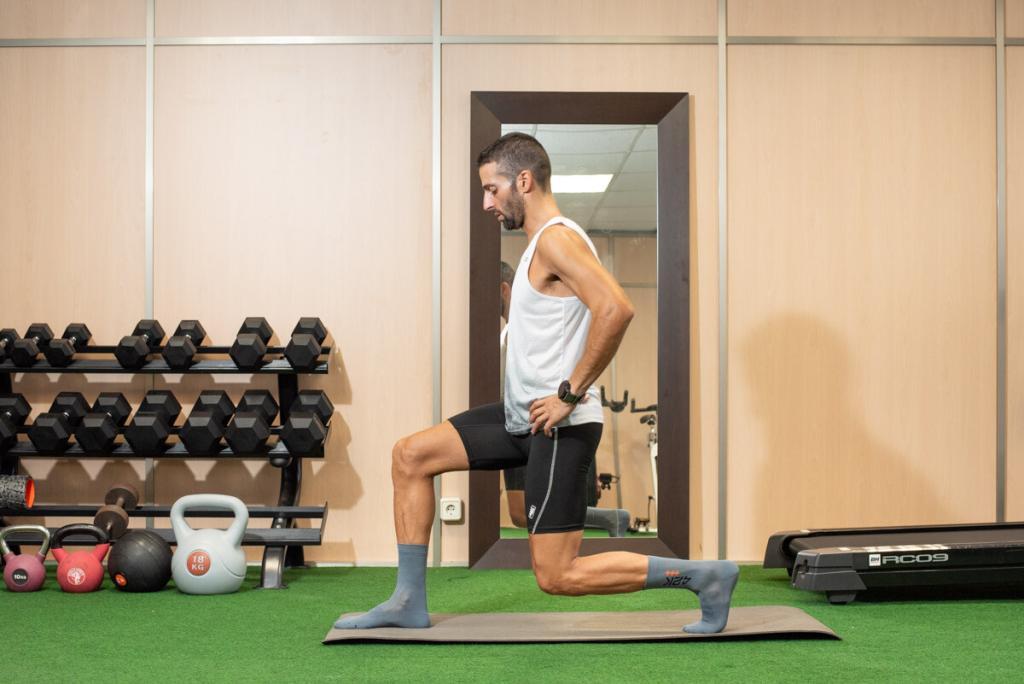
Like the squat, this is a multi-joint exercise that works various muscles, but with particular intensity on the thigh and hip muscles.
This is a unilateral exercise (the squat is a bilateral exercise) that works each leg independently. For this reason, lunges require a bit more coordination and strength level. At first it’s normal for this exercise to be a bit challenging to perform without losing balance, but in a short time and with a bit of consistency you’ll be able to do it effectively.
How to perform it? From a natural standing position, take a step forward with one leg and bend both knees until reaching a 90-degree angle; the knee that remains behind should not touch the ground.
Lower your body forward in a controlled manner, placing weight on one leg, and return to the starting position. The return to the starting position should also be controlled with the push of the front leg.
Important things to keep in mind with this exercise: the descent should be smooth and with a controlled braking action of the front leg. This braking action will work the quadriceps, glutes, and hamstrings. And a concentric phase returning to the starting position.
It’s very important for correct lunge execution to maintain vertical alignment of the body, avoiding trunk oscillations; the back should be straight during exercise execution, without arching. To avoid these ‘instabilities,’ it’s very important to have a strong core, which is why leg strength work should always be complemented with core strength work.
Benefits of lunges:
- Increased leg and glute strength and power.
- Increased balance and stability.
- Increased hip flexibility.
- Improved back posture. Lunges, like squats, work the abdominal and back muscles (core), which helps maintain better back posture and reduce the risk of discomfort or pain that running can cause.
Basic Leg Strength Exercises: 3. Bridges
Bridges are a compensatory exercise to work the posterior muscle chain, which suffers the most during long runs.
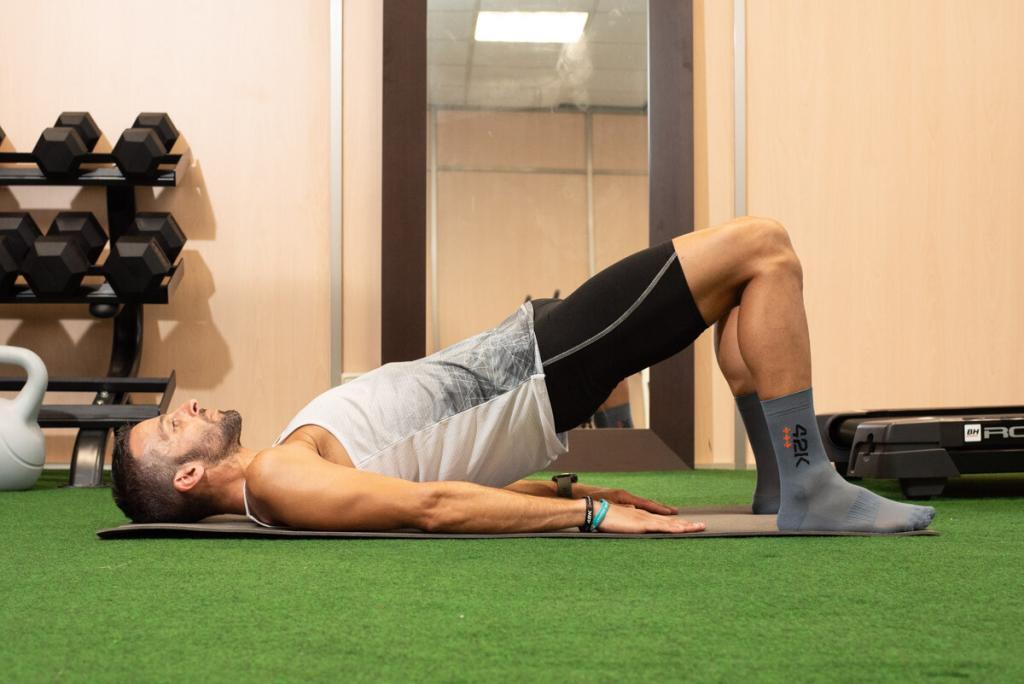
Generally, when performing leg strength exercises, you can make the mistake of giving more importance to working the front of the leg muscles but not as much to the back.
Bridges are especially useful for working and strengthening the glutes, a very large muscle group that perhaps doesn’t get the importance it truly deserves from runners. Additionally, this exercise works the lower back (core), hamstrings, and hip muscles.
From a lying position, place your shoulder blades and the soles of your feet (hip-width apart) on the ground and perform a hip extension, lifting your hips upward and returning to the starting position.
Important things to keep in mind when performing bridges: keep your core engaged so your back doesn’t suffer and squeeze your glutes. It may seem like the simplest of the three exercises, but it requires good execution to be truly effective. Make sure your shoulder blades stay flat on the ground and your spine is straight in a natural posture, without arching.
Benefits of bridges:
- Increased strength and power of the glutes and lower back muscles.
- Increased balance and stability.
- Increased hip flexibility.
- Improved upright back posture.
How to Perform These Basic Leg Strength Exercises?
Now you know how to perform the 3 basic leg strength exercises, but how often?
For people starting with strength training, my recommendation would be once a week performing 3 sets of 15 repetitions. For runners who already have an advanced level, I think it’s very beneficial to perform these exercises before your run, doing 2 sets of 15 repetitions.


Text for 42K by:
Marcos Greus
Coach and strength and conditioning trainer.
Graduate in Physical Activity and Sport Sciences, specialising in endurance sports. National coach in triathlon, cycling and swimming, as well as a long-distance specialist coach.
Other posts by Marcos Greus
Other posts that may interest you.

My first race: tips for handling the nerves and competing with confidence

What to eat before a half marathon: a nutrition guide to perform at your best over 21K


What factors does sports performance depend on? (Series 1: Energy systems)


Be the first to comment on this post!