
Subscribe to our newsletter to keep up with all the latest news and promotions, and automatically receive a welcome discount coupon in your email.

General search
42K

Be the first to know with the 42K newsletter!
CUSTOM

Customise your kit with our CUSTOMIZADOR!
CUSTOMISE NOW!
Iván Penalba now has his second finisher buckle from Badwater 135, a race unique even in its austerity. A very cowboy-style belt buckle and a commemorative t-shirt are the only prizes for completing its hellish 135 miles.
It doesn’t matter if you win like American Ashley Paulson with an astonishing time of 21h44′ (the first woman to achieve victory), if you finish twelfth like Iván Penalba with 29h48′, or if you finish in last place, 89th, with 46h34’—the prize is the same for everyone, although the condition is that you must finish within 48 hours (the maximum time set by the organizers).
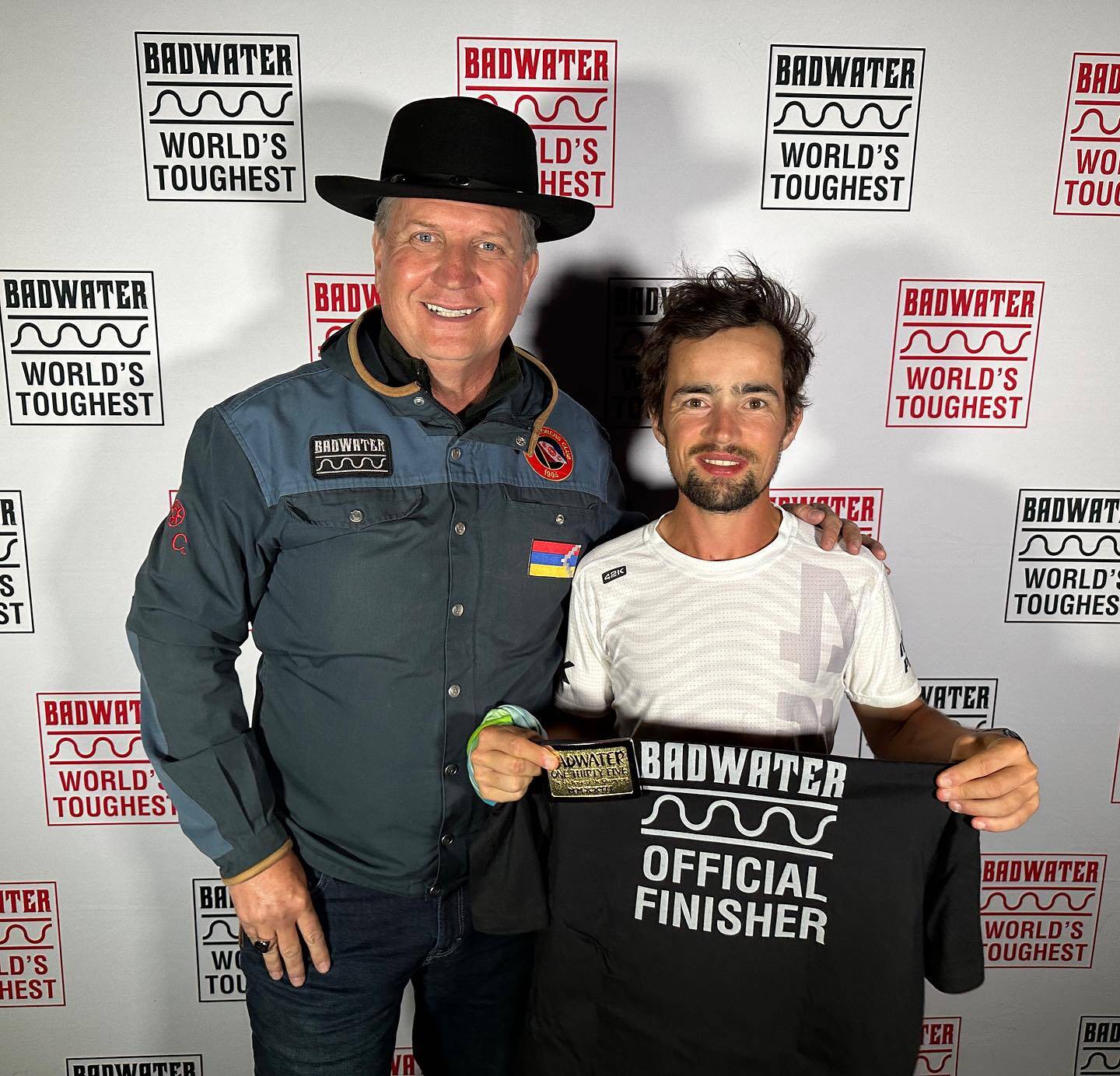
In the 2023 edition, 100 runners from 26 different nationalities started at Badwater Basin (Death Valley), of which only 11 failed to cross the finish line at Whitney Portal, at 2,530m altitude, on the route leading to the ascent of the highest peak in the United States, Mount Whitney.
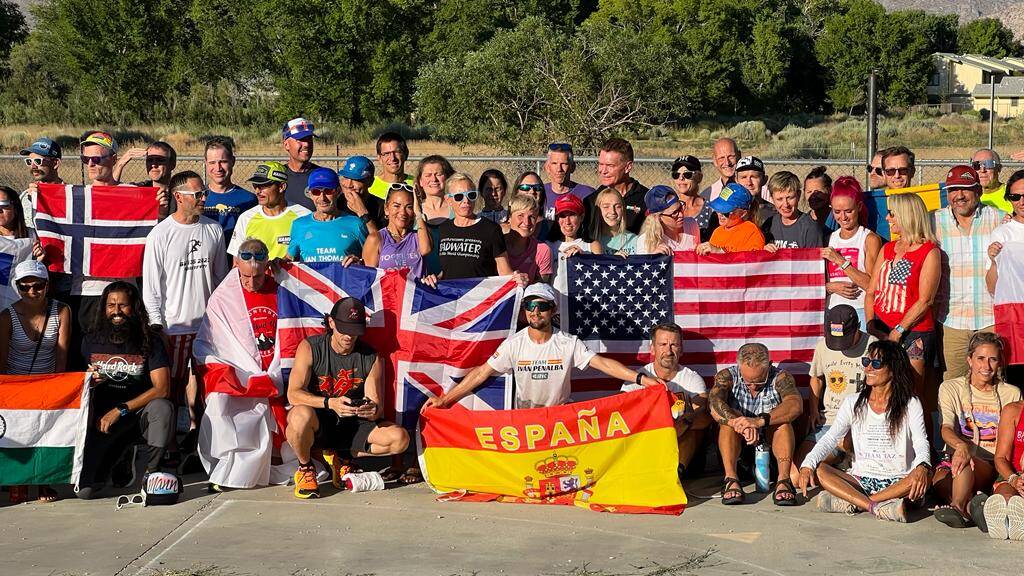
Iván Penalba died and came back to life at Badwater 135
One of the big favorites was Iván Penalba. The Spanish ultrarunner finished in second place in 2022, in his first participation, and in 2023 he started with the ambition and hope of being the first to complete the 135 miles (217 kilometers) of the most demanding ultrarunning race.
He decided to take risks from the start. Without fear of the scythe that Badwater 135 reserves for those who make mistakes or don’t know how to measure their strength. His ordeal began 3 hours into the race, after making several mistakes in his eagerness to seek victory.
At kilometer 170, with 45 kilometers to go to the finish, in the hottest and most inhospitable part of the course, his body said enough. He couldn’t take another step. He had been vomiting everything he drank and ate for hours. His legs were unable to continue, but his head and heart disagreed.
Everything suggested the worst, but Iván and his team didn’t consider withdrawal an option: he had to recover, come back to life, and return to the burning asphalt at nearly 80°C to complete the toughest part of the course. And collect the second buckle and commemorative t-shirt, the austere but symbolic prize that certifies being a finisher of Badwater 135.
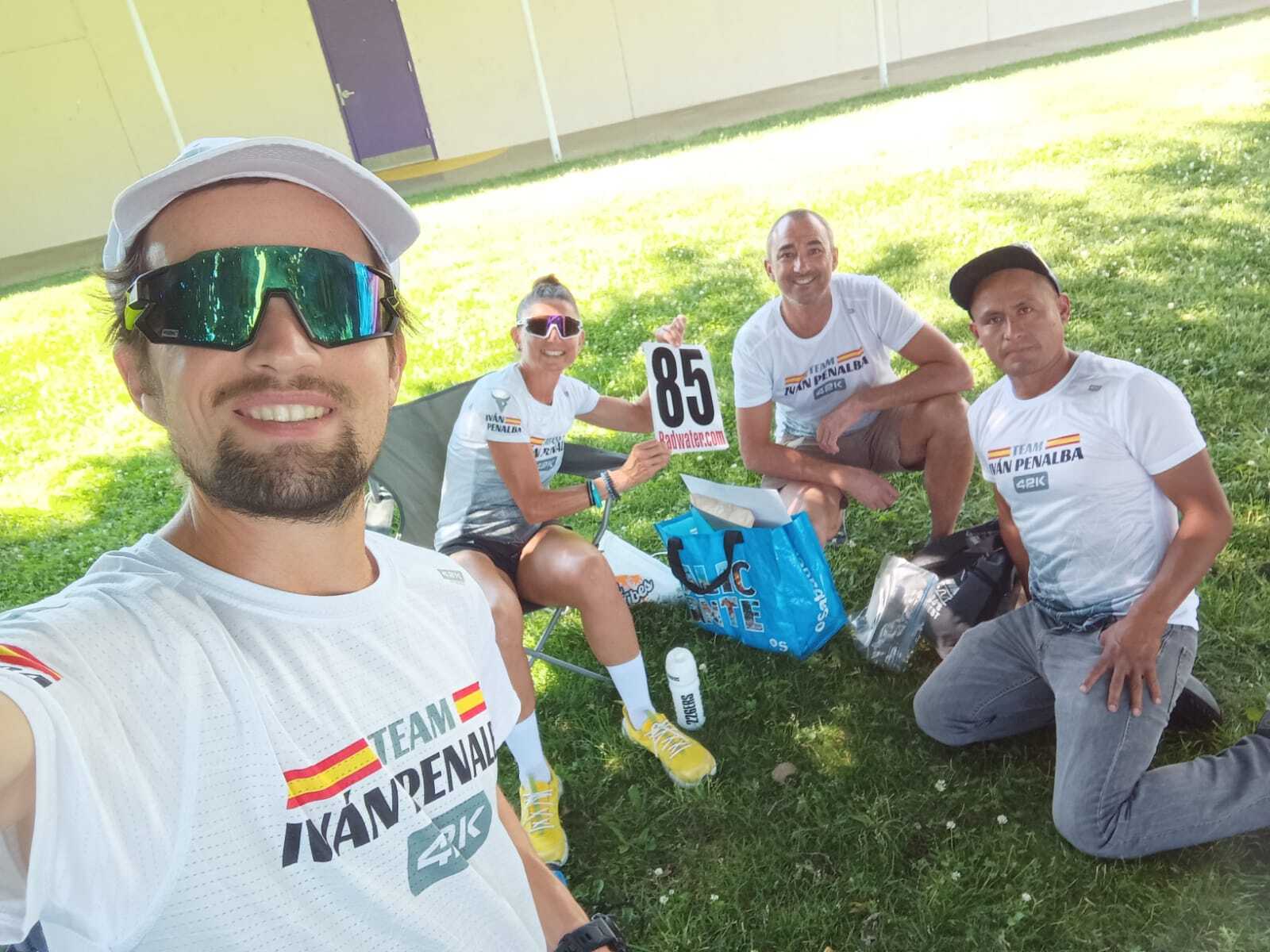
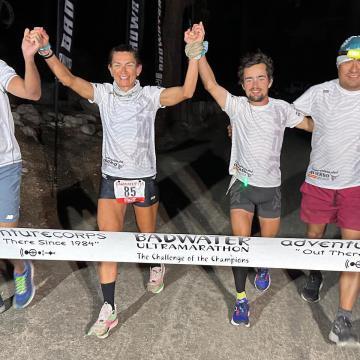
As soon as he crossed the finish line, with what little strength he had left, he hugged all the members of his team: Carmen Pérez, Joaquín Candel, and Oscar Hernández. “They saved my skin. At kilometer 170 I was dead, without the strength to stand. I was able to come back to life and finish thanks to them.”
Badwater 135 doesn’t forgive mistakes
Badwater 135 doesn’t forgive mistakes; if you make them, it tears you apart. It’s a race that demands excellence, an infinite capacity for suffering, and an unhealthy passion for the most extreme ultrarunning. Its 135 miles through Death Valley, with the merciless punishment of hellish temperatures (over 50°C during the day and no less than 34°C at night), are a torture rack from which it’s very difficult to emerge unscathed.
Penalba was the leader during the first three hours of the race and during that time he was in charge of pulling the group of favorites. “It wasn’t a smart decision because I took on all that effort by myself, because logically they didn’t give me any relief, but more than the effort it wasn’t smart because to stay in the lead I didn’t follow my nutritional strategy from the start and I didn’t stop to pee until three hours into the race,” the runner explains to 42K.
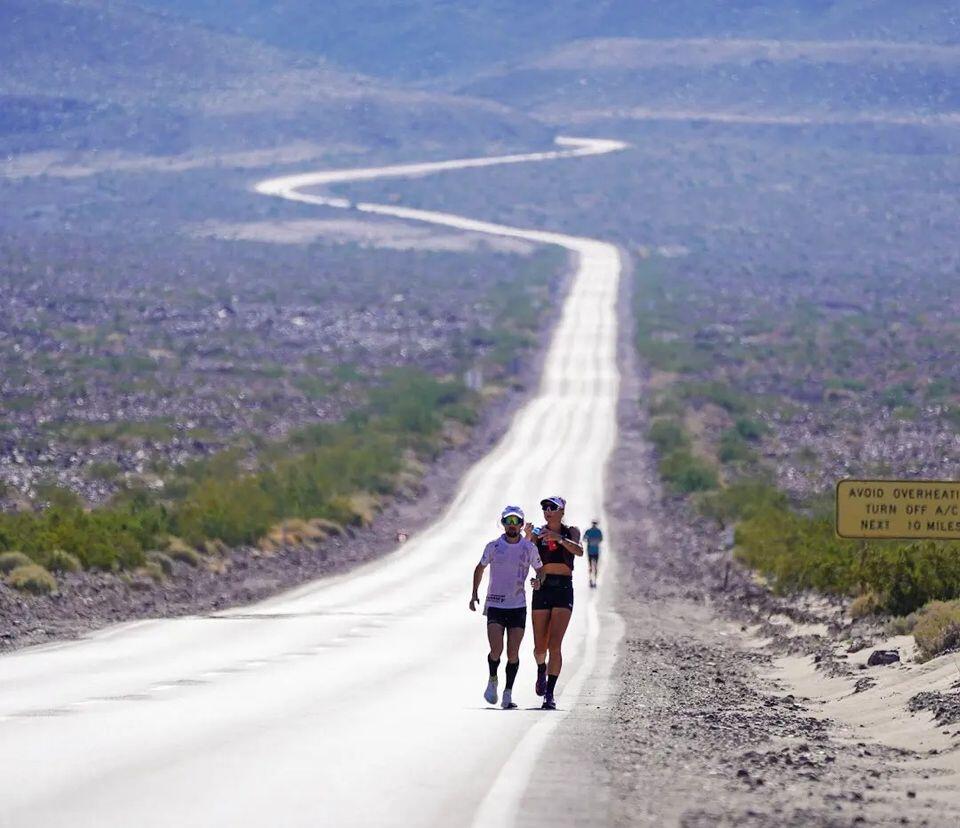
Three hours into the race, his body began to give warning signs: something wasn’t right, so he dropped back and slowed down.
“I tackled the first climb and didn’t do too badly, but I was already aware that things weren’t going well. I did the descent very fast, tremendously fast, more than a minute per kilometer faster than in 2022, hoping to catch up with the lead group again and continue aspiring to be on the podium. On the descent I emptied myself completely and didn’t drink enough, which was another mistake, and I finished the descent exhausted. The next climb, which was the really hard one, cost me a lot and that’s when I started having real problems; I crested as best I could and that’s when my body said enough and I went into collapse,” Iván explains.
42K: What do you mean by “I went into collapse”?
Iván: My body said enough. I had to stop because I wasn’t able to keep running. From that moment on, another race began for me. I wanted above all else to recover to finish in the most dignified way possible. When everything went wrong, my great hope became reaching the finish line and doing it with my best smile. The difficulty worsened when night caught me again, which was something I hadn’t anticipated, and which forced me to adapt to circumstances and difficulties I hadn’t foreseen.
42K: At what point do the sensations start alerting you that something isn’t right?
Iván: Everything was fine until two and a half hours into the race. Until that moment I was leading the race, with all the favorites behind me, locked into the pace I was setting. I tried to seek maximum performance from the start and made the mistake of not stopping to pee during the first hours. I wanted to go faster than I should and be in first position; being so stressed didn’t let me think clearly and follow my eating, hydration, and urination strategy. I held back the urge to pee so as not to lose the lead in the race and that was the beginning of all the problems that came later.
42K: What problems?
Iván: I stopped wanting to drink, eat, or even urinate. My body was retaining fluids and I began to clearly notice that I wasn’t well, so I decided to drastically slow down because I knew I could have a serious problem, especially in a race with such high temperatures. I tried to avoid collapse but it was already too late.
At kilometer 170 he was forced to stop, he couldn’t take another step
42K: Already dropped from the group of favorites, you kept fighting for hours until at kilometer 170 you were forced to stop.
Iván: The truth is I don’t even know how I made it to kilometer 170. That’s the most complicated part of the course because of the heat. A burning wind was blowing, a wind that scorched. I had vomited many times before reaching that point in the race, but that’s when I was left completely empty after vomiting for the umpteenth time. I stopped because I wasn’t able to take another step, there was no other option. Everything I drank or ate I vomited. I had to reset and pray for my body to stabilize a bit and allow me to resume the race to try to finish.
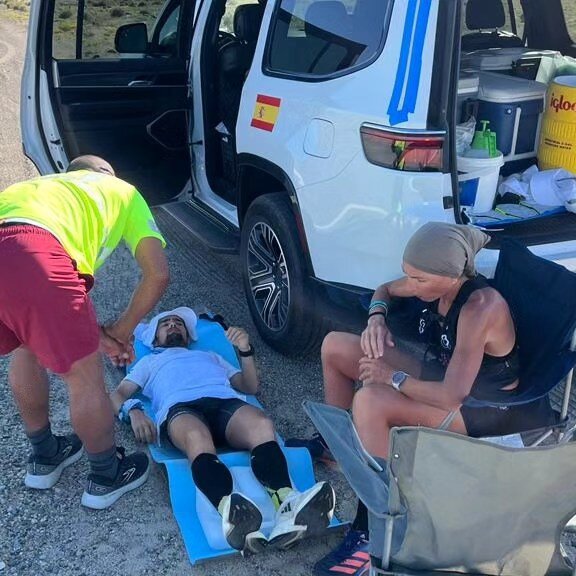
42K: How long were you stopped?
Iván: Around an hour and twenty minutes. I drank a little water and a little Coca-Cola, lay down, and started praying to stop vomiting. I kept telling myself not to rush, that I should let my body recover and that there was plenty of time to regain strength and continue to the finish. My goal from the moment I hit rock bottom was to recover the minimum strength to finish the race no matter what. I’ve never withdrawn from a race and it’s something I want to maintain throughout my athletic career: withdrawal is not an option. One of my great motivations as an athlete is to prove that with patience, perseverance, and a clear head you can always find a way to reach the finish, no matter how difficult or impossible it may seem. Everything seemed to condemn me to withdrawal, but with head and heart we found the way to continue to the end.
42K: Did the ghost of abandonment ever cross your mind?
Iván: Yes, because I couldn’t find a way to solve the problem: I couldn’t eat or drink anything without vomiting it immediately. With 45 very tough kilometers ahead, it was unthinkable to continue if I wasn’t able to hydrate and recover minimally. Fortunately, we had enough patience for my body to recover. I knew I had 48 hours to finish the race and at that moment my only challenge was to finish. I’m very satisfied with how I managed those terrible moments. Everything was against me, but I made an effort to be patient and push away all negative thoughts to avoid thinking about withdrawal.
In the last 10 kilometers he was falling asleep while running
42K: You had never run for more than 24 hours, but to finish this Badwater 135 you had to be running for almost 30 hours. What was that experience of something unknown to you like?
Iván: I had a hard time in the last 10 kilometers because sleep was overcoming me. I was jogging and walking and my eyes would close without being able to help it. Fortunately, I had Carmen by my side guiding and holding me because when my eyes closed I would veer to one side and stop going in a straight line. In the end, I had to stop and close my eyes for a few minutes because I wasn’t able to stay awake. It was a 5-minute micro-nap that worked great for me and helped me learn that these micro-sleeps can be very useful for long-distance races. I had never done it, but I know there are ultrarunners who use these micro-naps as part of their race strategy and I think it’s very positive and something I’m going to study for future long-distance races.
42K: What role did the team and especially Carmen play in those delicate moments?
Iván: Wow… Without the team I wouldn’t have been able to get past kilometer 170, but Carmen’s company in the final part was crucial to reaching the finish. She ran right behind me for more than 130 kilometers (the organization allows support runners, but always behind the competitor) and was fundamental to my being able to reach the finish. She was talking to me the whole time and finding ways to keep my mind occupied; even in the final part, when I was falling asleep while jogging, she invented games to keep me awake. She didn’t let me falter at any moment.
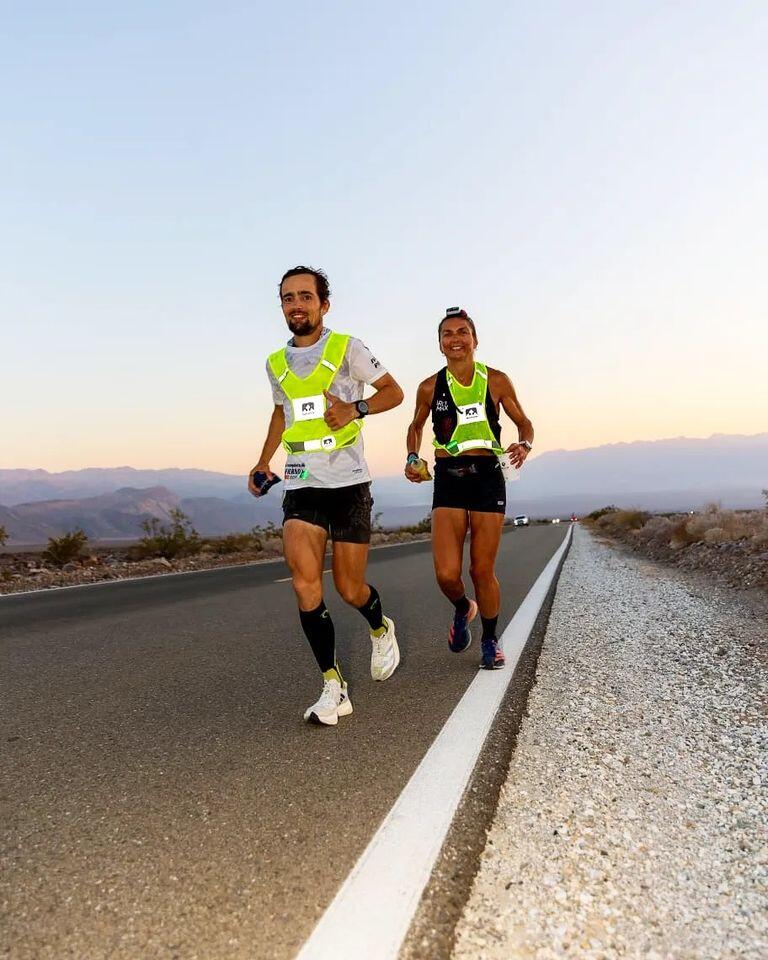
42K: Have you felt disappointed with the final result after so many months of work and preparation?
Iván: No. It’s true that we were seeking excellence, but the result is positive because despite the adversities we managed to reach the end in less than 30 hours in 12th position. And then you have to value the learning, because in a race like Badwater 135 you never stop learning things. I can’t be disappointed because I gave everything I had inside, everything and more, to finish. I would be disappointed if I had the slightest doubt about not having done everything possible to achieve the best result within my reach.
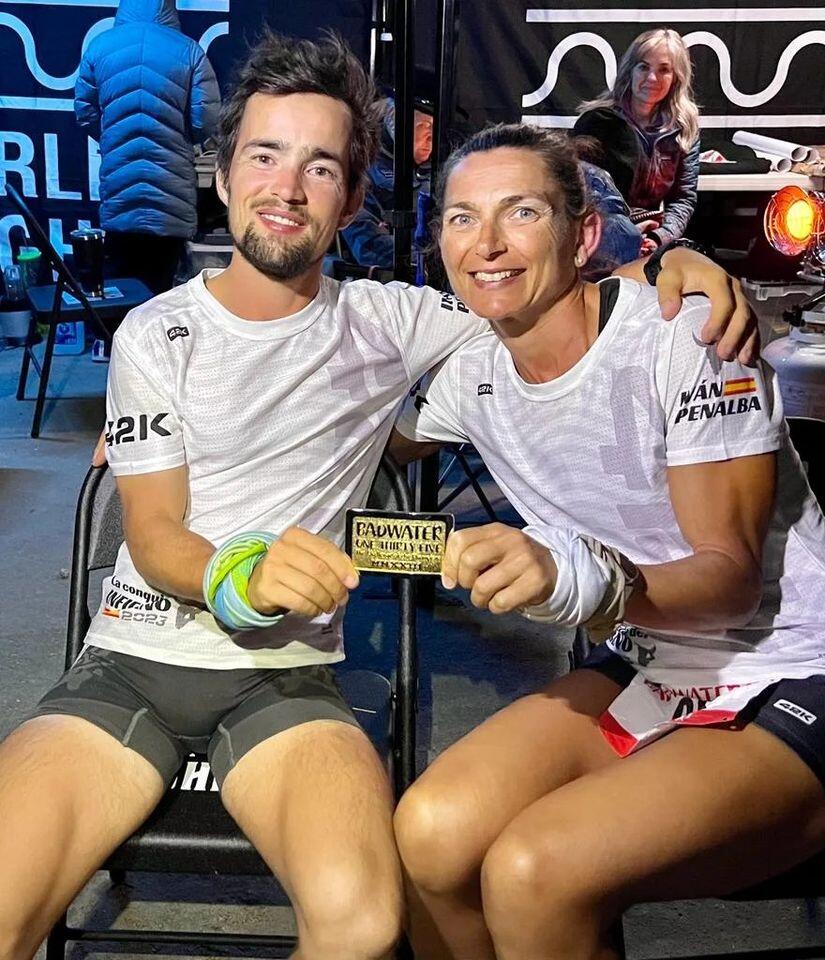
42K: What lesson or positive learning do you take from Badwater 2023?
Iván: On one hand, that you must always follow the established strategy, without improvisation and without making unnecessary mistakes. On the other hand, that there’s always a way out or a solution even when it seems impossible for any difficulty. Badwater 2023 has burned into my mind that as long as you don’t give up, you can always create an opportunity. You have to run with intelligence and a clear head; heart is very important in a race like this, but the key is to run with intelligence, with patience, without improvising, and above all, seeking inner balance.
Penalba on Ashley Paulson’s victory: “Women have a capacity for suffering and pain tolerance superior to men”
42K Were you surprised by Ashley Paulson’s victory, the first woman to win Badwater 135?
Iván: No. She’s an impressive, unique ultrarunner. Last year she already had a great race and this year she had prepared thoroughly to make history. Her victory confirms something I’ve been clear about for a long time: in ultrarunning races there are no differences between men and women; in fact, I dare say that women in this type of race have brutal potential because they have a capacity for suffering and pain tolerance superior to men. In the United States there have already been several outright victories by women in ultrarunning races. In ultrarunning events, speed is not the determining element, but endurance and the capacity for suffering. In some ultrarunning events, women may end up being the ones who set the bar at the highest and who set record times. Ashley’s example is the clearest proof of a woman who has defeated the best male specialists in the world’s toughest race. Her victory is very positive for ultrarunning because it can serve as an example and attraction for other women. Women, without a doubt, can aspire to compete on equal terms with men in ultrarunning.
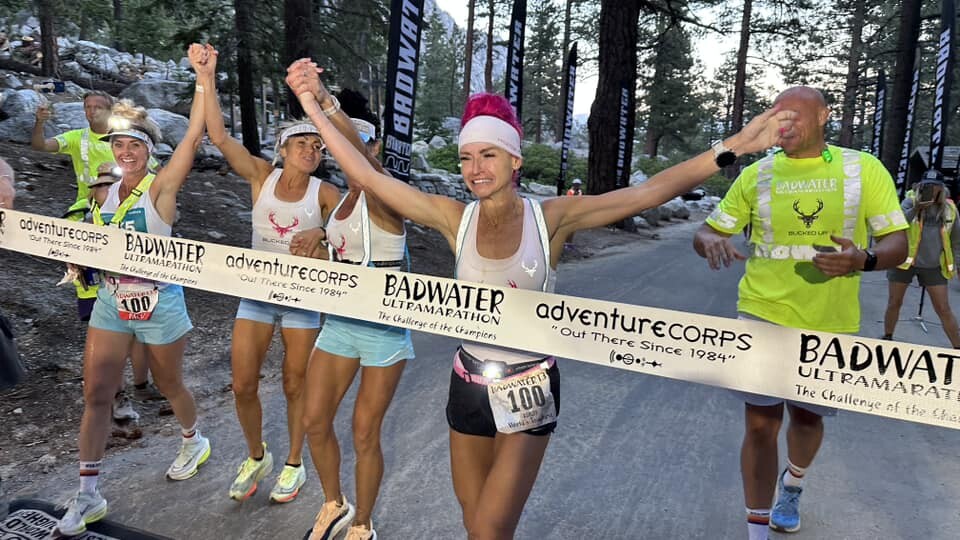
42K: Are you thinking about returning to Badwater?
Iván: Yes. It’s the race of my life. It’s the race of my dreams. I thought I was capable of fighting for victory this year but I got a reality check. It’s the world’s toughest race and it’s not easy to reach excellence. All the winners are over 40 years old and I’m currently 31. Maybe it’s a long road, but I want to return as many times as necessary to achieve victory. And if I ever achieve victory I’ll keep running it as many times as I can because it’s an inhuman race and that’s precisely what motivates and excites me about it. There’s no race in the world comparable to Badwater. I’ll run it again, but I’ll do it with my mind as peaceful as possible to face the tough moments in a calmer way.

Text for 42K by:
Paco Amorós
Head of Communications at 42K
Journalism graduate from the Universidad CEU Cardenal Herrera with a master's in digital marketing. Head of Communications at 42K.
Other posts by Paco Amorós




Be the first to comment on this post!