
Subscribe to our newsletter to keep up with all the latest news and promotions, and automatically receive a welcome discount coupon in your email.

General search
42K

Be the first to know with the 42K newsletter!
CUSTOM

Customise your kit with our CUSTOMIZADOR!
CUSTOMISE NOW!
Core training is essential for runners because it helps improve physical performance and also reduces the risk of certain injuries. Strengthening the core is necessary for the correct practice of many sports, but it is especially important for people who run on any surface: track, asphalt, cross-country, mountain…
‘Core‘ is an English word that means ‘núcleo’ in Spanish. When we talk about the core, we are referring to all the muscles in the midsection of the body: the abdominal muscles, the hip muscles, and what is known as the lower back (lumbar, glutes, pelvis, and the deep muscles of the back).
The core area is often defined as a “muscular belt” that supports and sustains the entire body. Runners and trail runners should work their core regularly to run more efficiently and safely.
In this article, we explain which muscles are part of the core, the benefits of core training for runners, and four basic exercises to work and strengthen the core without the need for equipment or accessories.
Benefits of core training for runners
Core training, and consequently the strengthening of all the muscles that comprise it, provides many benefits to the runner:
- Balance and stability are improved.
- More efficient breathing is achieved.
- The onset of fatigue is delayed.
- The risk of experiencing discomfort (especially in the lumbar area or lower back) is reduced.
- The risk of suffering injuries is reduced.
Good core training reduces the risk of injuries in runners
Why can core training mean fewer injuries for runners? The answer is very simple: a strong core leads to greater efficiency in movements, and this means running properly without adopting postures that cause discomfort or even injuries by forcing the improper or inadequate use of some muscles.
Correctly worked core muscles provide stability to the body, which is very important for running since there is never a moment when both legs are supported on the ground.
Likewise, core training will allow us to have better body and postural control both in any daily activity (walking, sitting, standing…) and when running or practicing countless sports involving running.
4 basic exercises to work the core
Coach and physical trainer Marcos Greus (INEF graduate specialized in high performance) recommends four basic exercises as core training for runners:
- Crunch.
- Plank.
- Side plank.
- Basic V.
These four exercises allow for easy, simple, effective, and safe core training from any level.
This video loads from YouTube, which installs marketing cookies.
Crunch
The Crunch is a basic and classic exercise to work the abdominal area very effectively.
“To do this exercise correctly, we must imagine that we want to curl up on ourselves so that the shoulder blades or scapulae lift slightly off the ground; it is enough to lift this area about 20º-25º from the ground and then lower back down. You should not exceed 20º-25º relative to the ground so that the back, especially the lumbar area, does not suffer”, explains Marcos Greus.

Plank
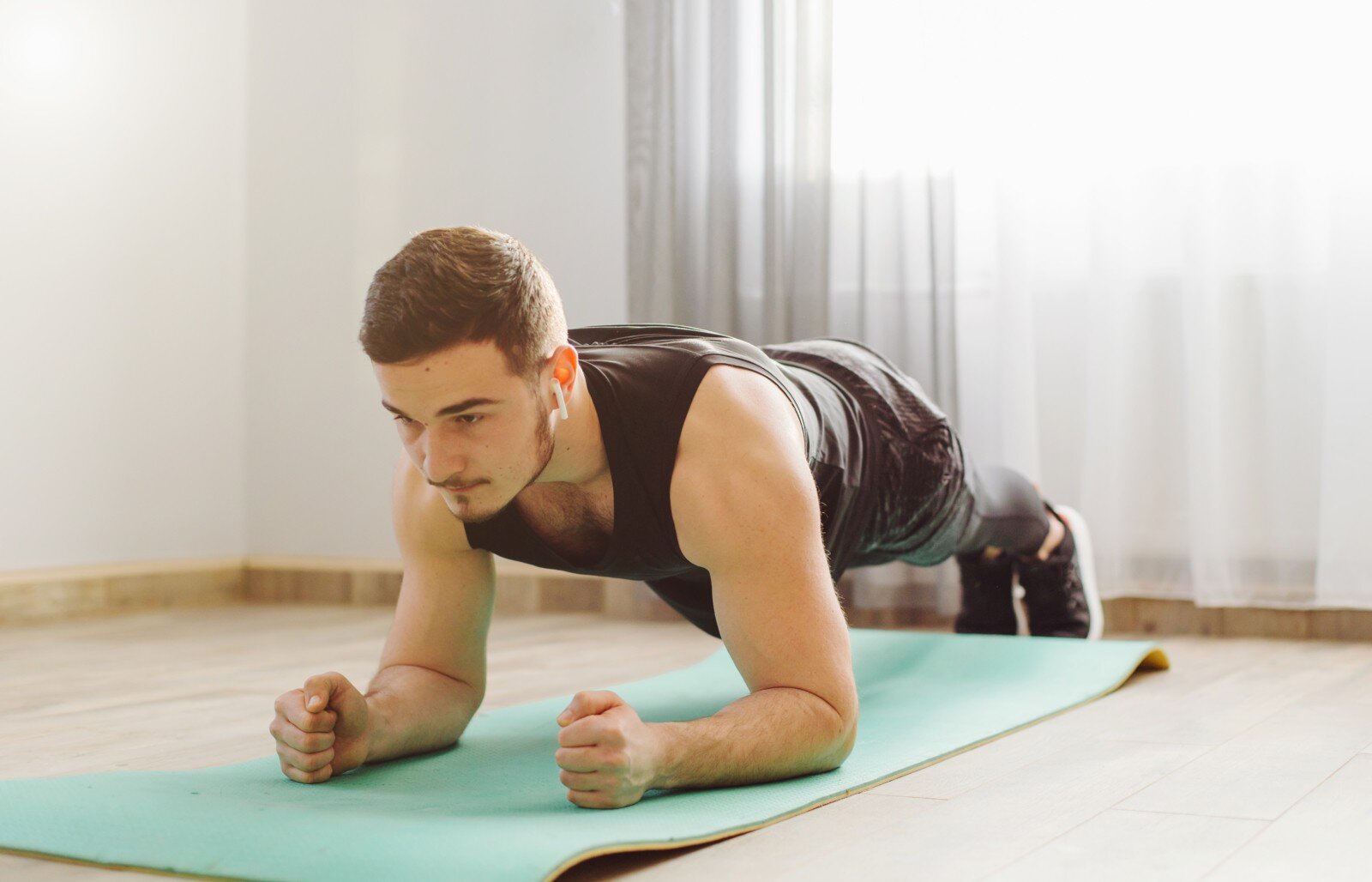
The front plank is an isometric exercise, meaning an exercise in which there is no movement but there is muscle tension.
“This exercise aims to keep the abdominal belt, both at the front and the back, in contraction without movement. Additionally, this exercise also works the accessory muscles of the obliques and the transverse abdominis”.
It is important to pay attention to the placement of the shoulders and elbows to perform this exercise correctly. “The elbows should be supported at a right angle and perpendicular to the shoulders to prevent the shoulder girdle from suffering”, emphasizes Marcos Greus.
The most frequent errors when performing this exercise are arching the back towards the ground or raising the hips above the shoulder line.
Side Plank
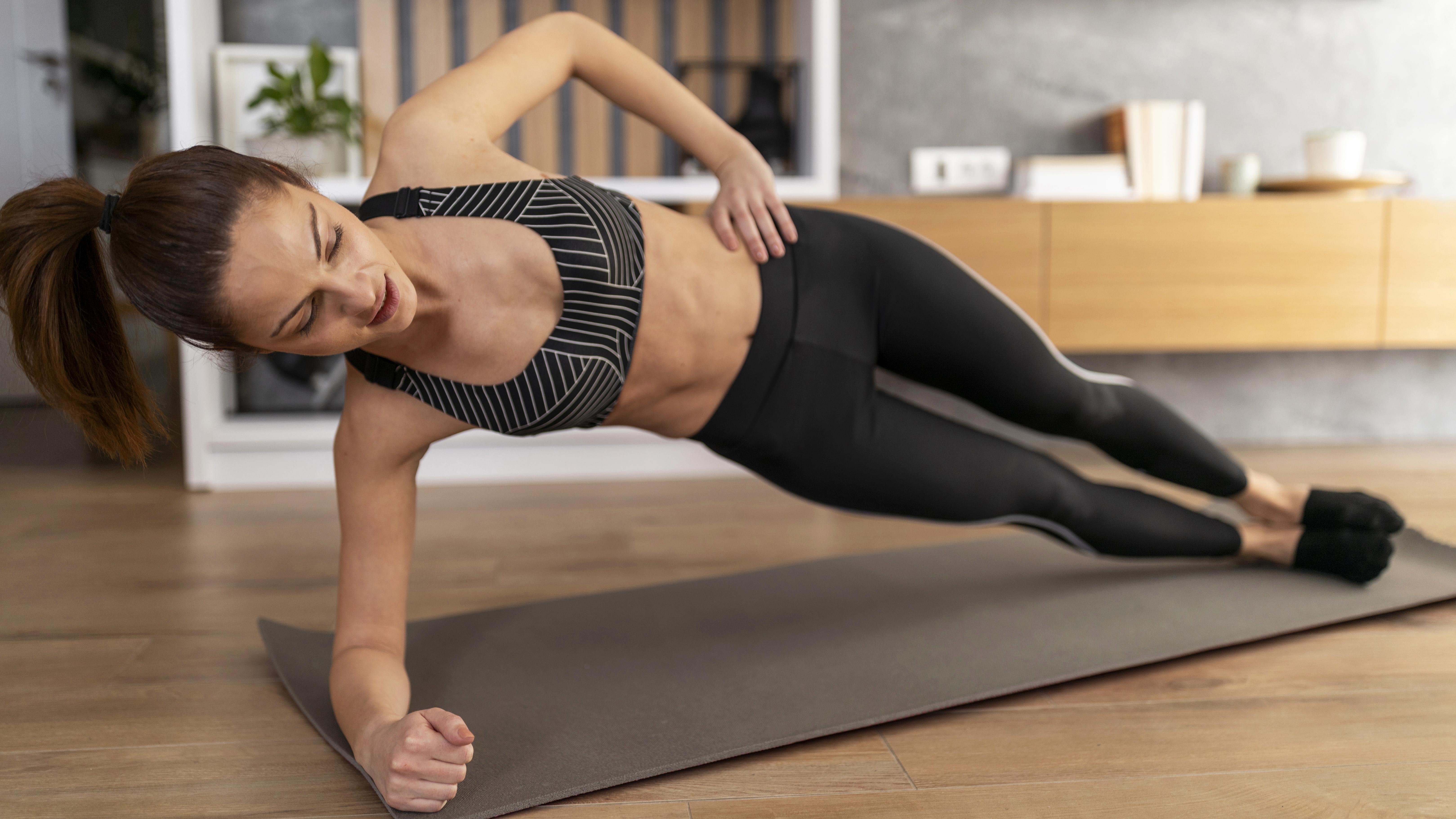
This is an exercise based on the front plank that concentrates the work on the transverse oblique area, as well as the rectus abdominis and the lumbar area. A very common error when performing this exercise is usually the excessive arching of the body downwards or upwards.
“When executing the side plank, it is important to pay attention to the importance of supporting the elbow correctly so that it is perpendicular to the shoulder and forming a right angle on the ground (as shown in the photo below) to prevent the shoulder girdle from suffering”, explains Marcos Greus.
Basic V
With this exercise, the abdomen and lumbar area are worked, but also balance with the involvement of accessory muscles of the upper area, such as the race bib and rhomboids, and the leg area, such as glutes, hamstrings, and quadriceps.
“A bit more experience is needed for this exercise because there is greater muscle involvement, but it is an exercise that should be worked on with patience because it brings very good results to the overall core work. People doing it for the first time should concentrate on correct execution without worrying about the number of repetitions at first. In a short time, as soon as they achieve some core toning, they will notice they are able to perform it more easily“, indicates Greus.
How to do the training? Follow “the rule of 3”
Now that you know how to perform the basic core training exercises for runners, it’s time to know how to plan their execution.
Marcos Greus explains that you have to apply “the rule of 3”: 3 sets of 30 repetitions or 30 seconds of action and 30 seconds of rest between sets.
“These are four exercises that, if performed regularly, will lead to a progressive and effective strengthening of the core. From these four exercises, you can continue to progress by increasing the number of repetitions or the action time, and also by including new exercises”.
So, you now know the importance of strengthening the core muscles and how to do it correctly with nothing more than a mat.
Credits:
Photo of Woman created by freepik – www.freepik.es
Photo of People created by bristekjegor – www.freepik.es
Photo of Woman created by freepik – www.freepik.es


Text for 42K by:
Marcos Greus
Entrenador y preparador físico.
Licenciado en Ciencias de la Actividad Física y el Deporte con especialización en deportes de resistencia. Entrenador nacional de triatlón, ciclismo y natación, además de entrenador especialista en larga distancia.
Other posts by Marcos Greus
Other posts that may interest you.

My first race: tips for handling the nerves and competing with confidence

What to eat before a half marathon: a nutrition guide to perform at your best over 21K


What factors does sports performance depend on? (Series 1: Energy systems)


Be the first to comment on this post!