
Subscribe to our newsletter to keep up with all the latest news and promotions, and automatically receive a welcome discount coupon in your email.

General search
42K

Be the first to know with the 42K newsletter!
CUSTOM

Customise your kit with our CUSTOMIZADOR!
CUSTOMISE NOW!
What happens when, while preparing for an important race, you overdo the mileage? You’re very likely to end up with iliotibial band injury or, as it’s more commonly known, runner’s knee or runner’s band.
Runner’s knee or iliotibial band syndrome
I remember that in 2015 I got a phone call on a Wednesday, four days before the Valencia Marathon. On the other end of the line, they said: “Hi David, I’m a friend of Jacob’s and he told me you can fix my runner’s knee problem for this Sunday, when I’m running the Valencia Marathon, and I want to set a personal best”. My reply was: “Setting a personal best will depend a lot on whether you can actually run on Sunday”.
I booked him in straight away and confirmed he’d built up excessive training, very demanding in terms of mileage; I also found he had an overly knock-kneed knee, an overly valgus ankle, and incorrect muscular timing that was activating the tensor fasciae latae and tightening it up to the point where he couldn’t run.
I told him I was going to patch up his runner’s knee problem to try to get him to race on Sunday, although I warned him I couldn’t guarantee he’d be able to finish. I decided on the following treatment:
- Dry needling and electro-needling of the tensor fasciae latae.
- A functional knee taping to align his knee on impact.
- An ankle taping to prevent the excessive valgus that was triggering activation of the tensor fasciae latae.
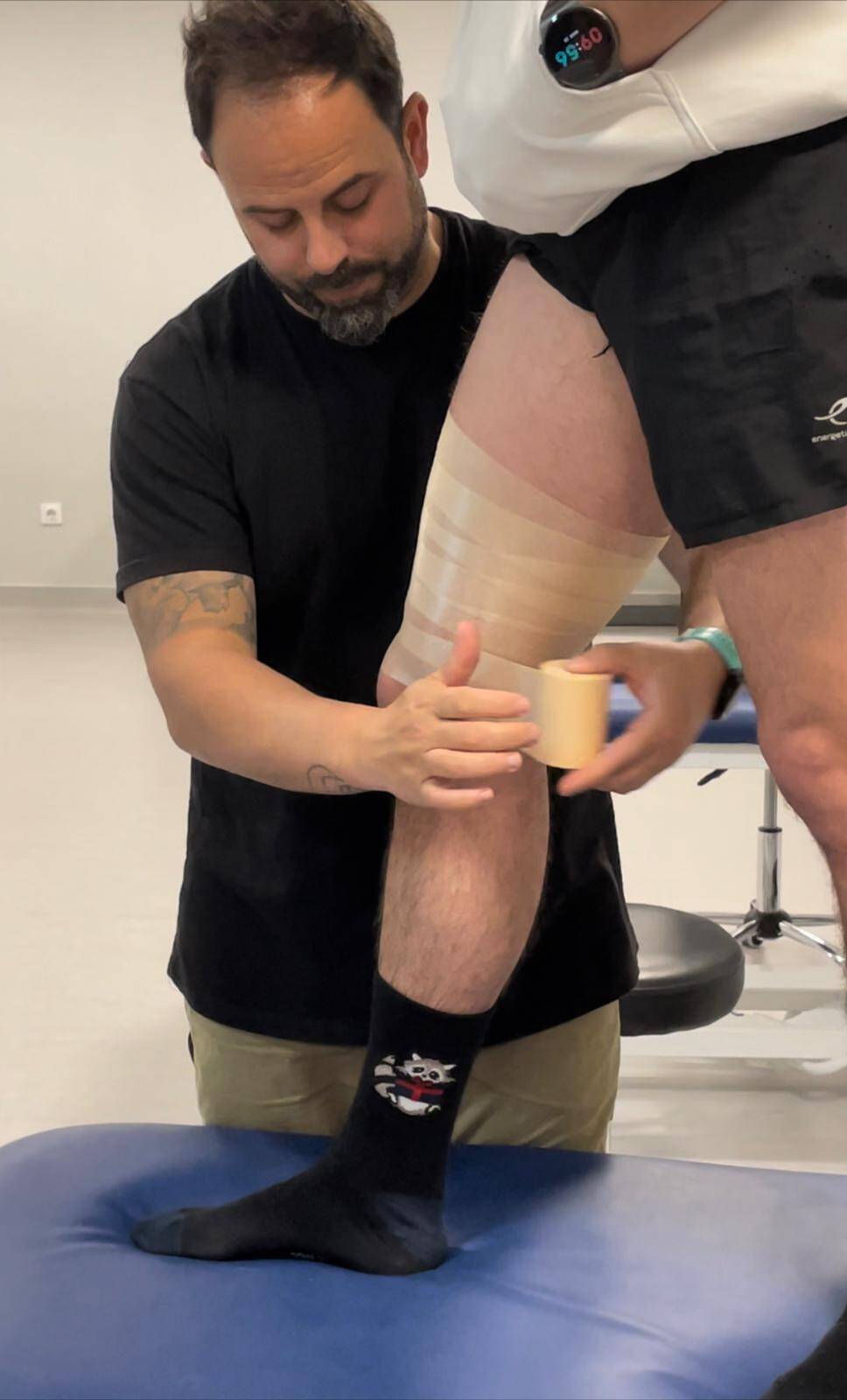
I asked him to try running 10 km the next day, Thursday (3 days before the race), and told him that if everything went well after that session, he could hope to make it to the start line of the marathon and consider the possibility of completing the 42.195 km despite his runner’s knee problem.
The next day he went out to train and ended up doing 18 km (not 10, as I’d told him) “because I felt good”. “With this, will I be able to finish the marathon?” he asked me after admitting he’d done 18 km; my answer was simply “we’ll try”.
Obviously, he didn’t know (and I didn’t tell him) that with every impact the knee and ankle taping would lose effectiveness and that little by little the pain would return; my hope was that he could get to km 25 without any issues and that from there he could hang on as the increasing pain set in.
This real situation I’ve described (and which has happened to me more times throughout my professional career) is something sports physios sometimes have to face. And in a situation like this you have to decide to do palliative physiotherapy—meaning you do whatever it takes so the athlete can compete—setting aside therapeutic physiotherapy, which would actually solve the problem.
But what is runner’s knee, or runner’s band?
Runner’s knee syndrome, or iliotibial band syndrome, is a common injury in runners whose training is too intense and who have accumulated too many kilometres in their legs.
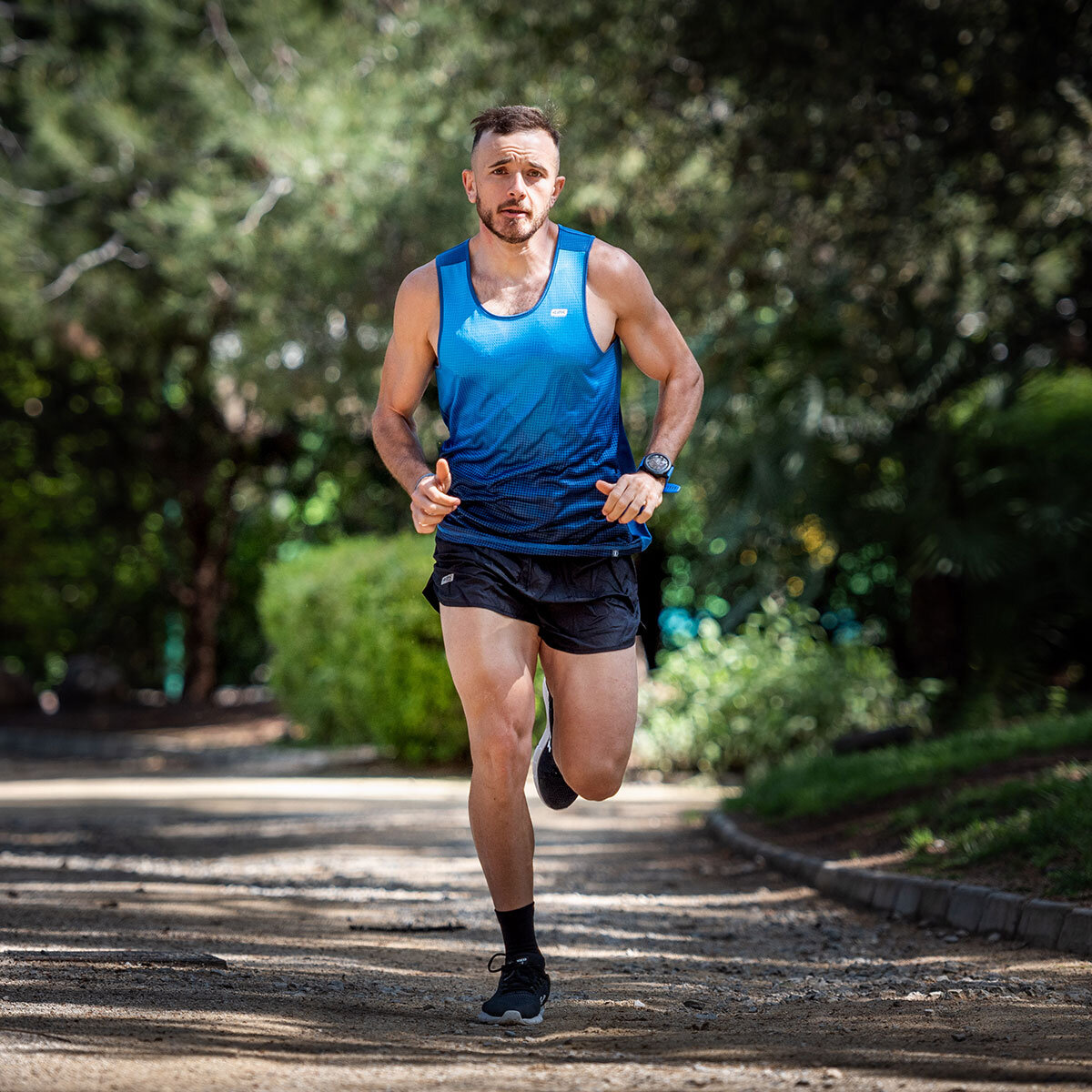
It’s an injury that starts with pain on the outside of the knee and gradually increases, becoming very intense during long runs or training with too many impacts. It’s a pain that starts mild and keeps getting worse until it turns into a painful burning sensation that eventually forces you to stop because the pain becomes unbearable.
The muscle affected—and the one behind the problem known as runner’s knee—is the tensor fasciae latae muscle; it’s a hip muscle with a long tendon that inserts into the outer side of the knee. When the pain starts, it’s normal to mistake it for a knee issue, but the real problem is in the hip’s tensor muscle.
A runner who lacks adductor strength and has limited abductor function will develop overload that causes knee pain. In other words, if they’re stronger on the outside than on the inside (adduction closes the leg and abduction opens it), having more strength in the abductor side (the one that opens) will create knee pain, but the real issue is in the hip.
What should you consider when assessing runner’s knee syndrome?
- Weakness in the hip abductor muscles due to overload.
- A runner with poor alignment when the foot strikes the ground, creating knee valgus or varus, will cause overstretching or weakness in the tensor fasciae latae.
- A runner’s short leg will create a weight shift that puts more load on one knee; to avoid scraping the ground, the athlete tends to run with abduction.
- Excessive ankle valgus due to loss of strength in the posterior tibialis will force the runner to lift the foot, creating poor flight in the stride and forcing the tensor fasciae latae to lift the leg.
- Multidisciplinary work between the physiotherapist, strength coach, and podiatrist to achieve good biomechanics for the patient.
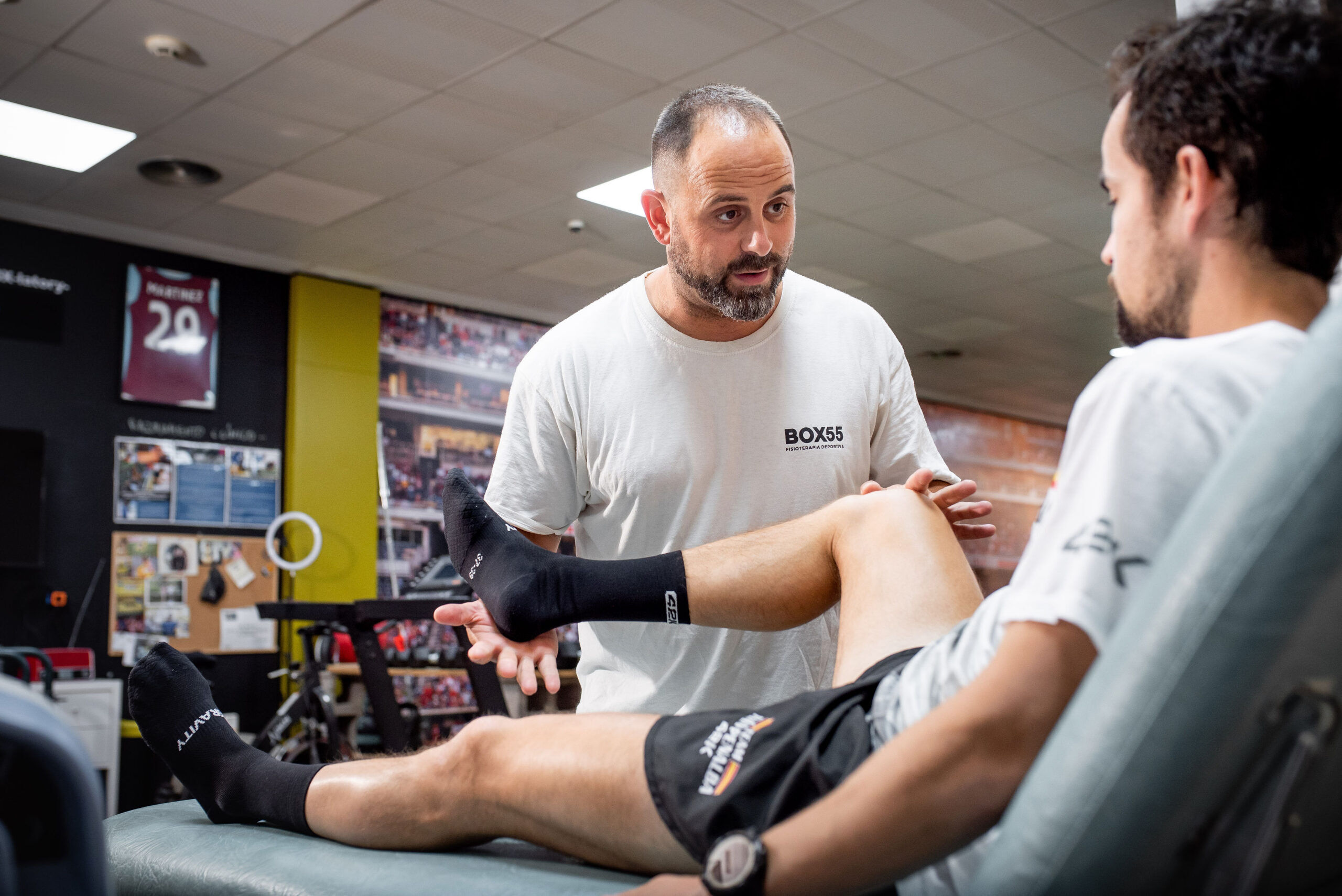
What should you do if you develop runner’s knee?
- First, keep in mind that if we work the muscles without controlling foot posture (plantar proprioception), we won’t be able to treat the injury.
- Second, remember that runner’s knee is actually a hip issue, so you need to improve hip mobility and strength.
- Third, you need to manage all the strength work for the intrinsic foot muscles to improve how the knee adapts to the ground.
- Fourth, you’ll need to do lower-mileage training.
- It’s a good idea to support rest periods with pool workouts and cycling sessions.
- See a physiotherapist once a week to improve muscular timing and reduce muscle tone.
Going back to the patient from the beginning, he was able to finish the race and even beat his time from the previous year. When he came back to the clinic on Monday after the marathon, I noticed the top of his foot was burned, so I asked what had happened and how he’d managed to improve his time.
He told me that around km 15 he had an incident at an aid station: “As I approached the aid station, I stepped on a banana peel without realising it, slipped, and slid under the aid station table, dumping all the cups of water over myself. The whole ankle taping got soaked and after a few kilometres it started rubbing, causing so much pain that I completely forgot about the knee pain. In the end, I pushed on and finished sprinting”, he explained with a smile, showing his second-degree burn on the top of his foot.
Moral: never stop chasing your dreams. In competition, any detail can help you reach your goals. Sport isn’t healthy, competition isn’t healthy, but the sports physiotherapist is there to understand you, support you, and with a bit of luck “heal” you.
Today, this patient is still running marathons with insoles, with a lower training load and less mileage build-up, with optimal hip activation, and with his knee and foot perfectly aligned so he can enjoy the sport he loves.
Congratulations to all runners who, come what may, have the courage to step up to a start line to go after their sporting challenges; sports physios will always be there with you.
More articles by David Valenzuela, sports physiotherapist at Box55
Sports physiotherapist David Valenzuela is one of the regular contributors to the 42K blog. Many endurance runners—trail running, track, etc.—come through his clinic, so he knows perfectly well what the main running injuries are, such as shin splints, plantar fasciitis, patellar tendinopathy and Achilles tendinopathy, lower back pain, hamstring tear, or ankle sprain.

Text for 42K by:
David Valenzuela Díaz
Fisioterapeuta en BOX55
David Valenzuela Díaz es diplomado en fisioterapia por la Universidad Cardenal Herrera CEU y Máster en valoración, fisioterapia y readaptación deportiva por la Universidad de Valencia. Es CEO de BOX55 Fisioterapia y Academia SL, de BOX55 Academy y de Valobando SL Functional Biomechanical Analysis.
Other posts by David Valenzuela Díaz
Other posts that may interest you.


Be the first to comment on this post!