
Subscribe to our newsletter to keep up with all the latest news and promotions, and automatically receive a welcome discount coupon in your email.

General search
42K

Be the first to know with the 42K newsletter!
CUSTOM

Customise your kit with our CUSTOMIZADOR!
CUSTOMISE NOW!
Groin Pain: What It Is, Where It Hurts, and How to Treat It
by David Valenzuela Díaz
Groin pain is an injury that causes pain in the pubic area, radiating toward the groin or lower abdomen. It is a common injury or condition in athletes who perform repetitive leg movements, such as track athletes and runners.
Groin pain has a very abstract medical diagnosis since it doesn’t define who or what causes the injury. For me, it is the most complicated injury to treat and you need to be precise in the diagnosis.
What Is Groin Pain and How Does It Affect the Body?
The hip is a very important joint in impact sports. It is the bone structure influenced by a crossroads of muscles that can alter balance and generate various conditions. To explain it with a graphic example: it’s like a tug-of-war game where both sides pull to see who wins, with the difference that the center is pulled in different directions by the force of the muscles that insert in the area.
This center, moreover, is the border that connects the lower limbs with the upper ones, generating an imbalance that starts with a small discomfort at the end of training, followed by continuous pain in the area and, suddenly, when sneezing or getting out of the car or turning over in bed, “all hell breaks loose” in the form of intense pain.
Normally the pain comes from a tendinopathy associated with tendons that are suffering an inadequate load—either excessive or insufficient—that they cannot transmit. And if it’s excessive, the problem is that the bone can break; if this happens, then we’re talking about a bone injury, a dynamic pubic osteopathy, which directly affects the structure that supports everything else and things get complicated in terms of time and symptoms.

In my opinion and based on all my years of experience as a sports physical therapist, groin pain is one of the most difficult injuries to treat if there isn’t a good physical therapy diagnosis.
Symptoms That May Suggest the Presence of Groin Pain
There are various symptoms that may make us think of groin pain, but I think it’s worth highlighting the following:
- Pain in the pubic area.
- Pain when sneezing and turning over in bed.
- Pain when opening the legs.
- Heaviness in the legs.
- Unable to do speed exercises.
- Muscle weakness.
- Lack of hip mobility.
- Almost unable to walk without pain.
How to Know If the Pain Actually Corresponds to Groin Pain
If you identify any of the previously described symptoms that make you think you might be suffering from groin pain, the immediate decision should be to see a specialist to determine the steps to follow.
My experience with this condition leads me to determine the following steps:
- Assess with an X-ray if there is bone involvement.
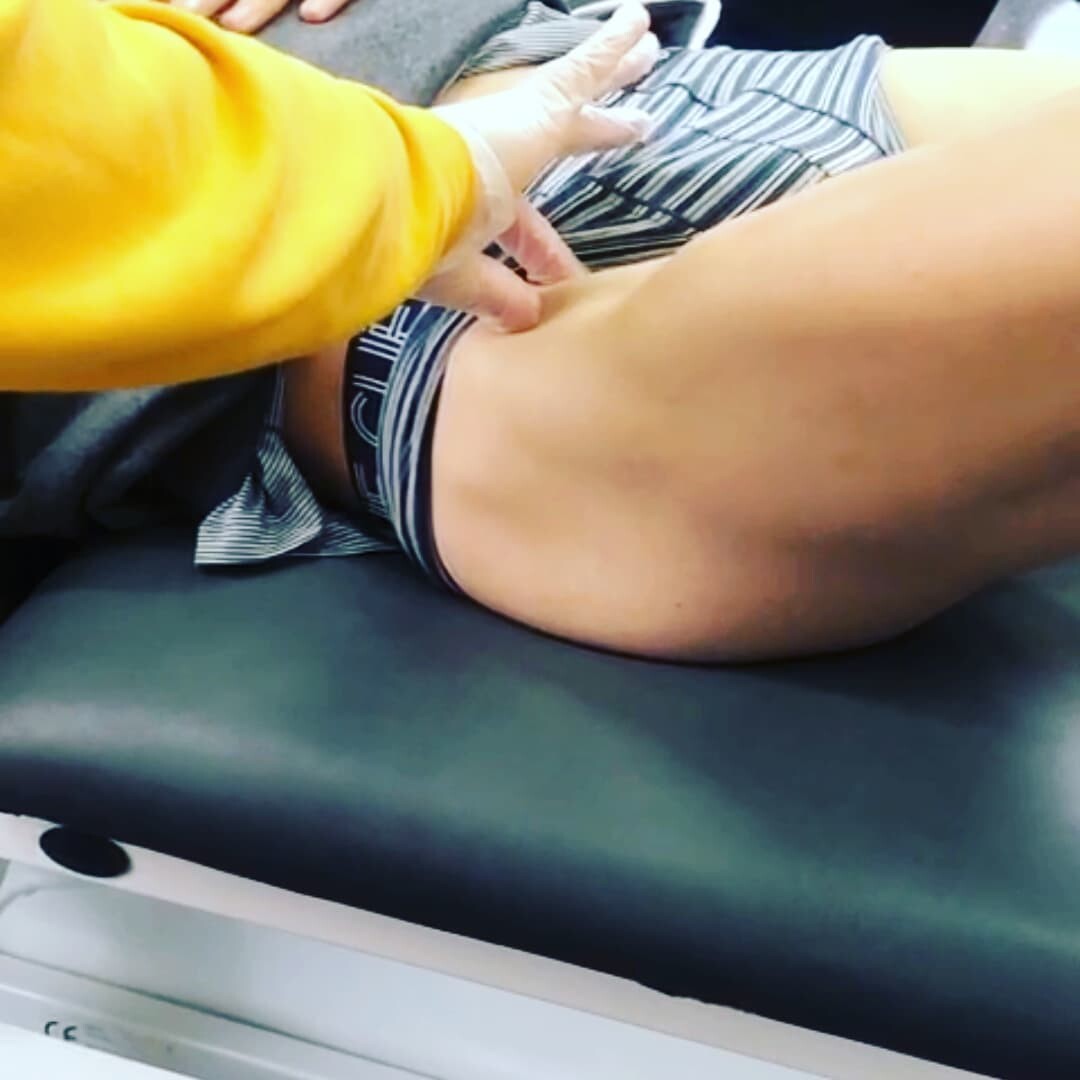
- Assess with an ultrasound if there is any muscle, tendon, or both involvement.
- Assess through physical therapy tests which muscles are affected.
- Assess if there is a leg length discrepancy.
- Assessment by a podiatrist of the postural sensor.
- Understand which structure is damaged and determine treatment time.
- See a sports physical therapist who plans work according to adaptive biomechanics for the injury.
Muscle and Postural Imbalances
- ABDOMINALS. Muscles that pull the pelvic area toward the head.
- PSOAS. Hip flexor muscle that affects posture.
- GLUTEUS MAXIMUS. Hip extensor muscle that affects posture.
- HAMSTRINGS. Muscles that position the hip and flex the knee.
- ADDUCTORS. Muscles that bring the leg closer and the insertions go directly to the pubis.
In other words, it affects all the muscles generating a contracture of all the muscles that insert there. This contracture creates a pain point that causes the body to be more comfortable in flexion and makes it difficult or impossible to stay upright. It is, in short, a “little old person” biomechanics in a young person.
Medical and Physical Therapy Treatments
Groin pain is an injury that if “treated” with Google gets worse quickly, so my advice is to see a physical therapist immediately, just as with other injuries like tibial periostitis, plantar fasciitis, or tendinopathy.

Considering that the healing time for a tendinopathy is indefinite, you need to be clear that this type of injury is treated with exercise and that it will be a long process.
The basis for curing this condition is to plan sports rehabilitation well, being aware that the goal is not to compete but to train. And to achieve with objective data improved movement quality and functionality in strength, endurance, and mobility of the affected muscles.
Groin pain is an injury that requires daily physical therapy work for healing.


Text for 42K by:
David Valenzuela Díaz
Physiotherapist at BOX55
David Valenzuela Díaz holds a diploma in physiotherapy from the Universidad Cardenal Herrera CEU and a Master's in sports assessment, physiotherapy and rehabilitation from the Universidad de Valencia. He is CEO of BOX55 Fisioterapia y Academia SL, BOX55 Academy and Valobando SL Functional Biomechanical Analysis.
Other posts by David Valenzuela Díaz
Other posts that may interest you.

My first race: tips for handling the nerves and competing with confidence

What to eat before a half marathon: a nutrition guide to perform at your best over 21K


What factors does sports performance depend on? (Series 1: Energy systems)


Be the first to comment on this post!