
Subscribe to our newsletter to keep up with all the latest news and promotions, and automatically receive a welcome discount coupon in your email.

General search
42K

Be the first to know with the 42K newsletter!
CUSTOM

Customise your kit with our CUSTOMIZADOR!
CUSTOMISE NOW!
How to Prevent Meniscus Injuries
by David Valenzuela Díaz
The menisci are the runner’s natural shock absorbers. Any sport involving impact, such as running, needs shock absorbers that optimize performance and prevent bone-on-bone contact. In this article we’ll analyze everything important to know about runners’ natural “shock absorbers” and, most importantly, how to care for them to prevent meniscus injuries.
A race like the marathon with its 42.195 km, assuming roughly half a meter per stride, means about 84,000 impacts that must be absorbed by the menisci, which as already mentioned serve as the knee’s natural shock absorbers.
Preventing meniscus injuries, a crucial task as they are the knee’s natural “shock absorbers”
But what are the menisci? What are they like? What function do they have? And most importantly: What should you do to care for them?
The menisci are fibrocartilaginous structures that exist between the femur and tibia to cushion the impact of the foot striking the ground. There are two menisci in each leg, the medial one shaped like a C and the lateral one shaped like an O. These structures absorb the pressure between the femur and tibia, which increases considerably when you start running or are above your ideal weight.
These structures need help from the muscles that affect the knee to protect and “separate” the intra-articular space, giving the natural shock absorbers room to perform their function.
Having strong legs, essential to prevent meniscus injuries
This means that a strong leg is the best way to help the menisci stay healthy and prevent meniscus injuries. Meniscal health is directly related to arthritis problems in the future, which is why strength training for runners is fundamental as preventive training.
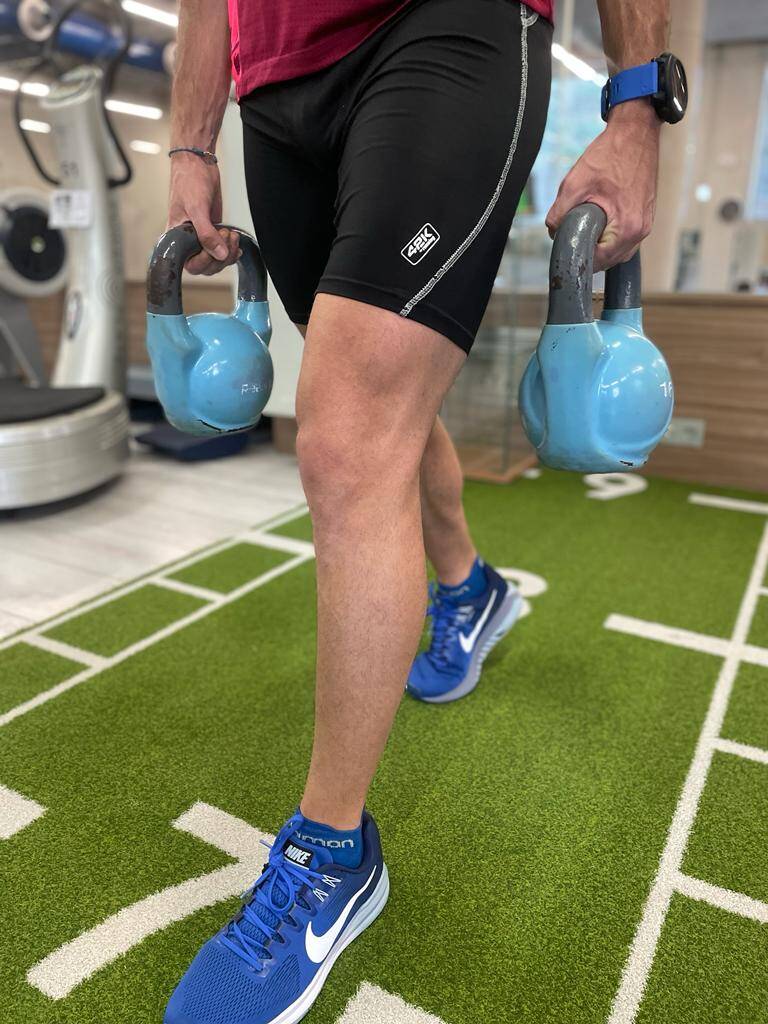
Hip muscle work is also necessary to prevent the knee from collapsing inward (valgus) and causing problems in the meniscal area.
Therefore, if you’re above your ideal weight and lack strength, I recommend starting with cycling sessions that will help you improve strength and avoid impact; with cycling, unlike what happens if you start pushing hard with continuous running, you avoid meniscal overpressure and prevent meniscus injuries.
Water-based work combined with strength training is key to preventing meniscus injuries. In water there’s a Lecrenier table that stipulates the body weight you lose depending on the depth at which you work, helping decompress the knee joint, which together with the resistance offered by water is the perfect combination to prevent injuries from intra-articular impingement.
Proprioceptive work (proprioception) that helps adapt the knee to the environment we work in is fundamental, so that if you experience an unexpected external stimulus you can adapt without getting injured.
Therefore, in the case of running, race preparation combined with lower body strength sessions, pool work, and proprioceptive exercises are key to maintaining good knee health and effectively preventing meniscus injuries.
But what injury mechanism can cause a meniscus tear? If there’s an obvious lack of strength, any mechanism of knee hyperextension or rotation with weight-bearing can result in meniscus injuries, especially to the medial meniscus, directly related to medial collateral ligament sprains (since it attaches to the medial meniscus) or the dreaded anterior cruciate ligament injuries.
To diagnose any type of meniscal injury, an ultrasound is necessary and, to be specific, a magnetic resonance imaging (MRI) scan.
Meniscal injuries can take many forms, from mild pinching and small tears to large tears or bucket-handle tears, injuries that destructure and crush the meniscus; it’s on these occasions that the surgeon will decide whether it’s necessary to suture or remove part of the meniscus if it cannot be recovered. Complete meniscus removal should be avoided to prevent future joint problems like arthritis.
Symptoms of a possible meniscus injury
Now, what symptoms make us suspect a meniscus problem or injured meniscus?
- Intra-articular knee pain; this is diffuse pain that doesn’t identify where it’s coming from.
- Locking that prevents complete knee extension or flexion, such as squatting or sitting on your heels.
- Pain when going down stairs.
- Inability to jump.
This injury can be assessed with orthopedic knee tests that a physiotherapist can perform, always confirming with an MRI scan and a visit to a specialist doctor who diagnoses the injury and decides whether it requires surgery or not.
The 7 golden rules to prevent meniscus injuries
So, what should you do to prevent meniscus injuries? Below are what I consider the 7 golden rules to effectively prevent meniscus injuries.
- Strengthen the leg, unloaded to avoid excessive pressure if there’s lack of strength or on a bike in case of excess weight.
- Strengthen quadriceps, hamstrings, and calves to improve the knee space where the menisci are located.
- Strengthen hip muscles, especially the gluteus medius to prevent knee lateralization.
- Include pool sessions to improve joint loading.
- Be progressive in workload and impacts.
- Visit a physiotherapist for prior assessment, injury prevention planning, and joint health maintenance through sessions interspersed with training.
- Prevention is better than cure.
Physiotherapist David Valenzuela, CEO of Box55 Fisioterapia, has also written articles for the 42K blog dedicated to functional taping and ankle sprains in trail runners. He has also reflected on how to prevent running injuries.


Text for 42K by:
David Valenzuela Díaz
Fisioterapeuta en BOX55
David Valenzuela Díaz es diplomado en fisioterapia por la Universidad Cardenal Herrera CEU y Máster en valoración, fisioterapia y readaptación deportiva por la Universidad de Valencia. Es CEO de BOX55 Fisioterapia y Academia SL, de BOX55 Academy y de Valobando SL Functional Biomechanical Analysis.
Other posts by David Valenzuela Díaz
Other posts that may interest you.

My first race: tips for handling the nerves and competing with confidence

What to eat before a half marathon: a nutrition guide to perform at your best over 21K


What factors does sports performance depend on? (Series 1: Energy systems)


Be the first to comment on this post!